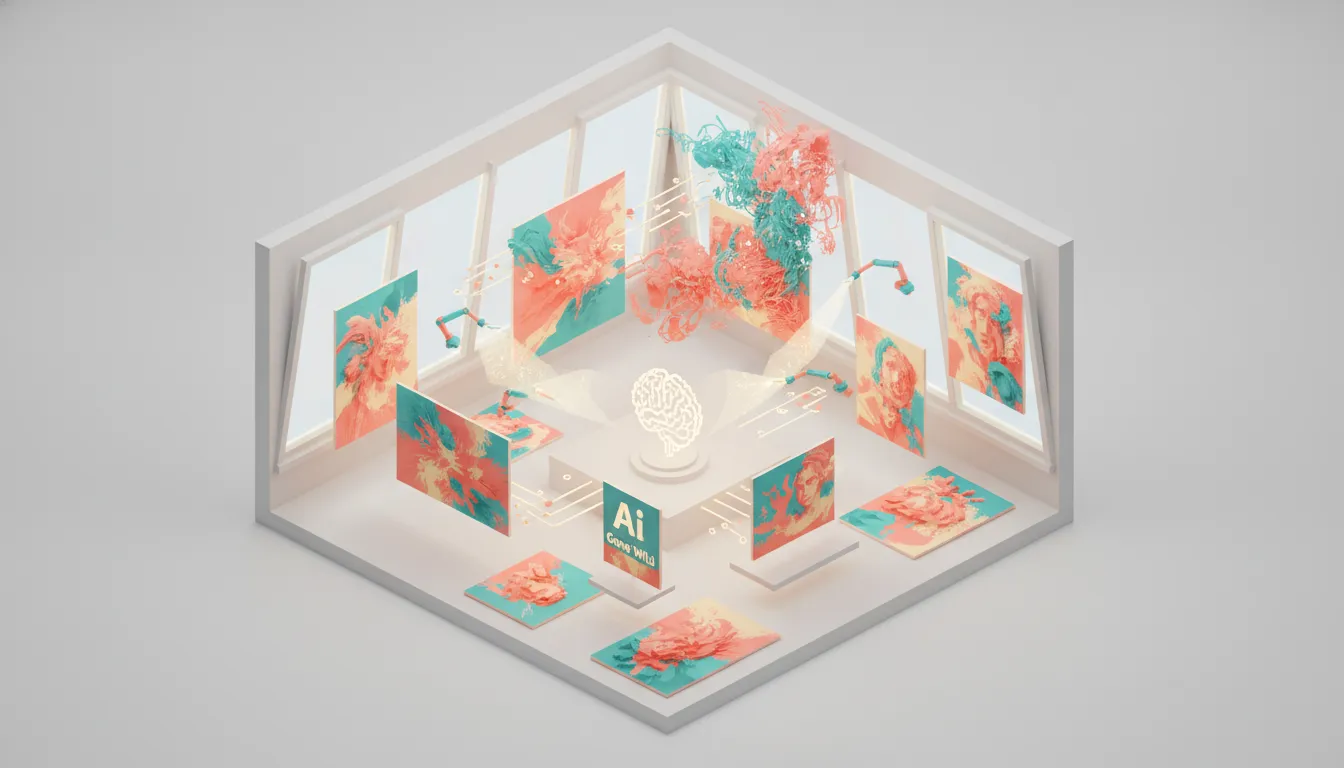
Imagine a world where every brushstroke is a line of code, and every masterpiece is born from algorithms rather than human hands. This isn’t science fiction; it’s reality in the burgeoning field of AI-generated art. According to recent data, over 70% of major tech companies are investing heavily in AI-driven creative tools, signaling a seismic shift in how we perceive artistic creation.
In just five years, these AI artists have painted their way into galleries and museum walls, challenging traditional notions of authorship and originality. One striking example is the painting “Portrait of Edmond de Belamy,” sold for over $432,000 at Christie’s auction house in 2018—a monumental milestone that marked the first AI-generated artwork to enter a major auction.
But this isn’t just about money or market value; it’s about pushing the boundaries of what art can be. These AI artists are not merely mimicking human creativity but expanding its definition, enabling new forms of expression and exploration. As we stand on the brink of an era where code is as much a medium for artistic creation as paint or pixels, one question looms large: Who will be the next Picasso born from lines of code?
The intersection of art and ai: how code shapes canvas
Artists are increasingly turning to artificial intelligence (AI) as a medium for creative expression, giving rise to a fascinating genre known as “AI-generated art.” This phenomenon is not just about the creation of digital paintings; it’s an exploration into how complex algorithms can mimic human artistic processes. In this analysis, we delve into the technical aspects that underpin these AI artists’ tools and techniques.
Architectural choices in ai art
The backbone of AI-generated artwork lies in its architecture—specifically, the choice between generative adversarial networks (GANs) and variational autoencoders (VAEs). GANs are a powerful tool for generating new images by pitting two neural networks against each other: one that generates images and another that evaluates their authenticity. VAEs, on the other hand, focus more on reconstructing input data while preserving its latent space representation.
For instance, when creating an AI artist like “Midjourney,” developers might opt for a GAN architecture to generate diverse and varied outputs from a limited dataset. This approach allows the model to learn complex patterns in images, leading to highly detailed and photorealistic results. However, it requires significant computational resources due to its adversarial nature.
Conversely, VAEs are often used when maintaining a certain level of control over the output is crucial. For example, an artist might use a VAE to generate portraits that closely resemble a particular style or era while ensuring the final images remain coherent and understandable. This method can be more efficient in terms of training time but may not produce as diverse results.
Concrete solutions for scalability and quality
As AI artists push the boundaries of what’s possible, scalability and quality become critical concerns. One solution is to implement distributed computing frameworks like Apache Spark or TensorFlow Distributed, which allow models to process large volumes of data more efficiently across multiple machines. This approach not only speeds up training but also enables the use of larger datasets, thereby enhancing the realism and variety of generated artworks.
Another key challenge in AI art is maintaining high-quality output despite potential overfitting issues. Techniques such as progressive growing during GAN training can help address this problem by gradually increasing the resolution of images without losing detail or quality. Additionally, incorporating style transfer algorithms alongside generative models ensures that the aesthetics remain true to a desired artistic vision.
In conclusion, AI artists are leveraging sophisticated technical solutions to push the frontiers of what’s possible in digital art. Whether through GANs for their ability to generate diverse and realistic images or VAEs for maintaining control over output quality, these tools represent significant advancements in both technology and creative expression. As this field continues to evolve, we can expect even more innovative applications that blend human creativity with machine learning capabilities.
Future frontiers
The boundaries between art and technology are blurring, heralding an era where code crafts masterpieces. For developers, this means embracing AI as both tool and collaborator, pushing creative limits unimagined before. Engineers will find new frontiers in generative models, enhancing not just visuals but user experiences across mediums. Tech leaders must navigate these landscapes by fostering innovation while ensuring ethical guidelines underpin every pixel and line of code. The horizon is vast; it’s time to paint the future with both brushstrokes and algorithms.