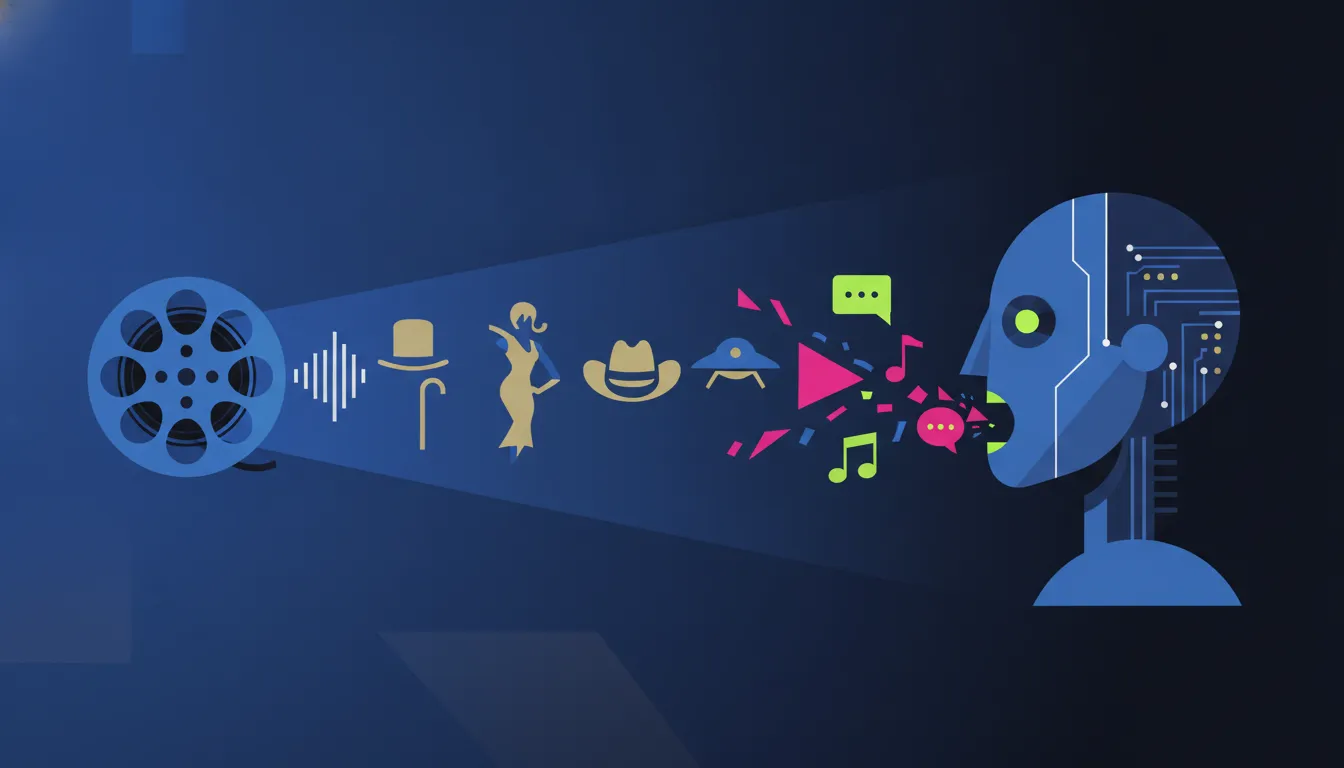
Historical film preservation has historically been constrained by the physical limits of cellulose nitrate, acetate degradation, and the destructive fidelity loss inherent to variable-density optical soundtracks. For decades, restorative engineering focused purely on subtractive post-processing: notch filtering to remove mains hum, spectral de-hissing, and manual decrackling via interpolation algorithms. These tools attenuate noise, but they cannot synthesize missing acoustic information. When optical wear or mechanical degradation strips away harmonic overtones, intelligibility drops, leaving classic dialogue muffled, hollow, or permanently clipped.
Modern synthetic acoustics and neural speech processing, powered by enterprise **Tech AI** pipelines, have transformed this domain from mechanical restoration to predictive generative reconstruction. Deep neural vocoders, cross-lingual diffusion architectures, and latent space voice morphing now allow sound engineers to isolate, model, and resynthesize the vocal performances of mid-twentieth-century cinema icons. By treating degraded celluloid audio as incomplete data matrices rather than fixed waveforms, engineering teams can regenerate full-bandwidth, emotionally faithful vocal tracks that integrate into immersive modern audio formats like Dolby Atmos and 7.1 surround sound.
—
1. The Physics and Signal Degradation of Legacy Audio
To understand how synthetic vocoding models historic performances, one must examine the acoustic pathology of legacy optical audio systems. From the late 1920s through the 1950s, cinematic dialogue was captured through ribbon or dynamic microphones with hyper-specific frequency response curves, routed through analog vacuum tube preamplifiers, and printed directly onto film margins via variable-area or variable-density optical tracks.
“`
+—————————————————————+
| Optical Film Sound Degradation Chain |
+—————————————————————+
| Ribbon/Carbon Mic –> Non-linear Vacuum Tube Harmonic Saturation
| |
| Variable-Density Exposure –> Optical Grain Clustering & Emulsion Scratches
| |
| Playback Phototube Exciters –> Low S/N Ratio & 8 kHz Cutoff High-End Drop
+—————————————————————+
“`
These physical pathways introduced systemic acoustic bottlenecks:
1. **Bandwidth Restriction**: Early optical audio rarely captured frequencies above 7.5 kHz to 8 kHz. Fricatives (such as /s/, /z/, /f/, and /θ/), which rely on turbulent air escaping between the teeth and palate in the 4 kHz to 12 kHz region, suffer acute phase smear and dynamic flattening.
2. **Harmonic and Non-Linear Distortion**: Vacuum tube amplification saturated upper dynamic ranges. Peak vocal deliveries, such as screams, shouts, or sudden emotional shifts, drove the recording medium into severe clipping, generating odd and even harmonics that contaminated the underlying formant signatures.
3. **Mechanical Instabilities (Wow and Flutter)**: Irregular motor speeds during recording or projection introduced continuous, micro-tonal frequency fluctuations. This introduces time-variant jitter into the fundamental frequency ($F_0$) track, undermining pitch stability.
4. **Noise Profiles**: The mechanical friction of projector transport systems, paired with chemical breakdown of the film base, creates high-amplitude surface clicks, low-frequency hum (50/60 Hz), and broadband emulsion hiss.
Subtractive digital signal processing (DSP) approaches, including Fast Fourier Transform (FFT) noise gating, attenuate hiss by muting spectral bins falling below an arbitrary decibel threshold. However, this creates “musical noise”—swirling, phase-shifted acoustic artifacts that hollow out the actor’s vocal resonance. Generative restoration, driven by specialized **Tech AI** models, bypasses this limitation. Rather than merely filtering the damaged recording, it decodes the underlying linguistic and acoustic parameters to reconstruct the voice from its elemental mathematical characteristics.
—
2. Neural Audio Architectures for Voice Inpainting and Synthesis
Synthetic voice reconstruction relies on an explicit separation between two computational layers: **acoustic feature modeling** (which translates linguistic tokens and condition vectors into intermediate representations like mel-spectrograms) and **neural vocoding** (which synthesizes time-domain audio samples directly from those spectrograms).
“`
[Raw Degraded Audio]
│
▼
[Spleeter / Demucs Stem Separation] ───> [Isolated Vocal Stem]
│
▼
[Whisper ASR Phonetic Alignment]
│
▼
[Acoustic Feature Extractor (F0, Timbre)]
│
▼
[Latent Diffusion / Flow Matching]
│
▼
[HiFi-GAN / BigVGAN Vocoder]
│
▼
[Pristine 48kHz / 24-bit PCM Master]
“`
Acoustic Modeling: From Autoregression to Latent Diffusion
Early speech synthesis relied on autoregressive architectures like Tacotron 2, which predicted mel-spectrograms frame by frame. While highly natural, autoregressive generation suffers from slow inference speeds and compounding error propagation, making it prone to phantom phoneme repetition or missing syllables—unacceptable outcomes when matching legacy dialogue to an actor’s lip movements.
Modern archival pipelines use non-autoregressive acoustic generators based on **flow-matching** and **denoising diffusion probabilistic models (DDPMs)**. These networks operate directly within continuous latent spaces:
* **Text-to-Spectrogram Alignment**: Using models like FastSpeech 2 or VITS (Variational Inference with adversarial learning for end-to-end Text-to-Speech), linguistic transcriptions derived through automatic speech recognition (ASR) are mapped directly onto the temporal domain via Monotonic Alignment Search (MAS).
* **Prior Distribution Learning**: The model maps phoneme inputs, paired with pitch ($F_0$) and energy contours, into a latent representation $z$. A reverse diffusion process iteratively strips away Gaussian noise, guided by conditioning vectors extracted from the actor’s surviving clean vocal snippets.
* **Bandwidth Extension (Super-Resolution)**: Where historical audio lacks data above 8 kHz, diffusion architectures formulate the problem as an image inpainting task on the linear or mel-scaled spectrogram. The network predicts the high-frequency harmonic overtones based on the preserved fundamentals, effectively re-establishing the missing air and brilliance of the human voice.
Neural Vocoding: Bridging Spectrograms to 48 kHz / 96 kHz Waveforms
Once the acoustic model predicts an uncorrupted, full-bandwidth mel-spectrogram, a neural vocoder synthesizes the raw, one-dimensional pulse-code modulation (PCM) waveform.
Architectures such as **HiFi-GAN**, **BigVGAN**, and **Vocos** dominate this phase:
* **Multi-Scale Discriminators (MSD)**: Analyze the audio waveform across varying temporal resolutions, forcing the generator to produce accurate phase coherence over long periods (preventing robotic vibrato) as well as short bursts (capturing crisp plosive transients like /p/, /t/, and /k/).
* **Multi-Period Discriminators (MPD)**: Apply 2D convolutions over 1D audio reshaped into matrices of periodic intervals, ensuring that the harmonic structures tied to the actor’s fundamental pitch retain physical authenticity without ringing artifacts.
By coupling non-autoregressive latent diffusion with multi-period adversarial vocoders, technical teams restore truncated optical audio into master-quality, 24-bit/48 kHz or 96 kHz tracks indistinguishable from modern reference-grade studio captures.
—
3. Disentanglement and Conditioning in Latent Timbre Spaces
Reconstructing an iconic performance requires reproducing not just an approximation of the voice, but the precise vocal signature of a specific human being at an exact point in their biological lifespan. Timbre is deeply personal; the vocal fold geometry, laryngeal tract length, and dental architecture of an actor define a unique set of resonant cavities (formants).
Enterprise voice modeling separates an audio signal into four discrete, disentangled vectors:
$$mathbf{X} = f(mathbf{c}_{text{content}}, mathbf{s}_{text{speaker}}, mathbf{p}_{text{pitch}}, mathbf{e}_{text{emotion}})$$
Where:
* $mathbf{c}_{text{content}}$ represents the underlying phonetic information (phonemes, pauses, and durations).
* $mathbf{s}_{text{speaker}}$ represents the time-invariant speaker identity embedding (timbre, laryngeal structure, nasal resonance).
* $mathbf{p}_{text{pitch}}$ tracks the fundamental frequency ($F_0$) contour over time.
* $mathbf{e}_{text{emotion}}$ encapsulates dynamic energy shifts, spectral tilts, and vocal stability markers.
“`
[Historical Vocal Clip]
│
┌────────────┼────────────┐
▼ ▼ ▼
[Content] [Speaker] [Emotion/Prosody]
Vector (c) Vector (s) Vector (e)
│ │ │
└────────────┬────────────┘
▼
[Disentangled Fusion Engine]
│
▼
[Restored, Resynthesized Vocal]
“`
Extracting Timbral Embeddings via Zero-Shot Cloning
When training a model to replicate a deceased actor’s voice, the target data pool is fundamentally finite. If an actor starred in twelve films, the usable source audio might total only a few hours once musical cues, background Foley, and partner dialogue are stripped out.
Engineers extract target embeddings using deep feature encoders such as **x-vectors** or **ECAPA-TDNN** (Emphasized Channel Attention, Propagation and Aggregation Time Delay Neural Network). These networks project brief audio windows into a continuous hyperspherical metric space:
1. Cosine similarity operations measure distance between the target actor’s clean samples and the generated candidate audio.
2. The model optimizes an angular margin loss (Additive Angular Margin Softmax, or AAM-Softmax), forcing embeddings from the same speaker to cluster tightly while pushing separate speakers outward.
3. This cluster isolates the static physical attributes of the actor’s vocal anatomy, preventing background room ambiance or microphone coloration from bleeding into the extracted timbre.
Historical Dialect and Transatlantic Stylometry
Mid-century cinema relied heavily on stylized performance habits, most notably the Mid-Atlantic (or Transatlantic) accent—a cultivated phonetic mixture of Received Pronunciation and General American. Actors systematically deployed non-rhoticity (dropping the /r/ in words like *water* or *car*), elongated vowels (turning /æ/ into /ɑː/), and sharply flapped dental consonants.
If standard, modern multi-speaker models ingest historical transcripts, they tend to normalize these accents toward contemporary speech distributions. Engineers mitigate this by designing custom phoneme mapping dictionaries that replace standard International Phonetic Alphabet (IPA) tokens with dialect-accurate sets. The system freezes the phonetic transcription layer to preserve historic pronunciation choices while allowing the neural vocoder to repair dynamic and spectral fidelity.
For content producers expanding beyond cinematic audio into full-stack modern publishing, combining specialized synthesis with semantic engines is increasingly standard; this strategy mirrors methodologies explored in Ai-crafted content: the future of seo and web design mastery, where structural discipline maintains organic brand identity across digital touchpoints.
—
4. End-to-End Restoration Pipeline: Step-by-Step Implementation
Deploying an end-to-end voice restoration pipeline demands strict workflow hygiene. Processing raw, archival optical masters through a generative pipeline requires several interdependent stages to maintain absolute temporal synchronization with the visual projection.
“`
+—————————————————————————————+
| Archival Generative Restoration Pipeline |
+—————————————————————————————+
| Stage 1: Ingestion & Spectral Deconstruction (48 kHz/24-bit optical tape capture) |
| │ |
| Stage 2: Blind Source Separation (Conv-TasNet / Demucs v4 deep vocal isolation) |
| │ |
| Stage 3: Forced Phoneme Alignment (CTC-based segmentation, sub-millisecond sync) |
| │ |
| Stage 4: Latent Synthesis & High-Frequency Inpainting (Infilling above 8 kHz) |
| │ |
| Stage 5: Phase-Aligned Multi-Track Re-Mastering (Spatial reconstruction) |
+—————————————————————————————+
“`
Stage 1: High-Resolution Ingestion and Pre-Processing
The archival soundtrack is transferred flat from the physical media using continuous optical film scanners or high-output playback heads. The capture standard must remain uncompromising: uncompressed 24-bit/96 kHz linear PCM.
Engineers run baseline de-clicking and phase realignment to eliminate lateral displacement errors. At this stage, no destructive spectral suppression is applied.
Stage 2: Deep Vocal Source Separation
Classic films rarely maintained separated multitrack elements; dialogue, orchestral scores, and Foley sound effects were permanently bounced down to a mono stem. To restore the voice, it must first be isolated.
Engineers deploy deep neural networks for source separation, such as **Demucs v4** (a hybrid spectrogram and waveform model) or **Conv-TasNet** (Time-domain Audio Separation Network):
* The network isolates vocal transients from complex orchestral beds by learning time-frequency masks.
* Complex-valued spectrogram representations allow the network to track acoustic phase, preventing the phase-cancellation smearing that classic center-channel extraction tools generated.
* The output yields an isolated, degraded vocal track alongside a separate music-and-effects (M&E) track.
Stage 3: ASR Decoding and Forced Phoneme Alignment
The isolated vocal stem is fed into a robust automatic speech recognition model (such as OpenAI’s Whisper or fine-tuned Wav2Vec 2.0). Rather than relying on public model weights, engines are primed using the original shooting scripts as explicit prior constraints:
* **Connectionist Temporal Classification (CTC)**: Computes the precise temporal boundary of each spoken phoneme down to the millisecond.
* **Lip-Sync Ground Truth**: Timestamps must correspond to the actor’s visual mouth kinematics down to the individual film frame (typically 24 fps, or 41.67 milliseconds per frame). Any drift in the generative output results in glaring uncanniness.
Fine-tuning textual cues and script metadata aligns with the semantic optimization techniques outlined in Ai-crafted meta descriptors: the secret sauce for instant visibility boost, where targeted algorithmic inputs ensure tight alignment with programmatic constraints.
Stage 4: Acoustic Inpainting and Synthesis
With the phoneme sequence locked to absolute time anchors, the system generates the voice:
1. The low-frequency fundamental components ($F_0$ up to approximately 2.5 kHz) from the original recording are preserved to capture the actor’s immediate prosodic intent.
2. The missing mid-to-high frequency registers (formants $F_3$ through $F_5$, spanning 3 kHz to 16 kHz) are inferred using a diffusion-based generative vocoder conditioned on clean acoustic profiles of the actor.
3. The vocoder re-synthesizes the upper harmonics, applying real-time micro-pitch corrections and room-impulse adjustments to eliminate optical grain while preserving breath dynamics, lip-smacks, and vocal fry.
Stage 5: Final Spatial Mastering and Integration
The pristine synthetic vocal stem is remixed with the restored, re-orchestrated music and Foley tracks. Engineers apply dynamic convolution reverbs using synthetic impulse responses (IR) matching the set geometry seen on screen.
The dialogue is panned into multi-channel arrays, creating an authentic soundstage that meets modern audio expectations while honoring historic performance dynamics.
—
5. Technical Challenges: Cross-Lingual Dubbing and Visual Parity
One of the most powerful applications of modern voice synthesis is non-destructive multilingual localization. Historically, foreign-market dubbing severed the connection between the actor’s physical presence and their performance: local voice talents with entirely different vocal timbres delivered translated lines, often struggling to match the visual syllable timings of the original footage.
“`
[Native English Source] ──> [Neural ASR + Machine Translation] ──> [Target French Script]
│ │
[Speaker Timbre Vector] [Phoneme Stretcher]
│ │
└───────────────────────────────┬───────────────────────────────────┘
▼
[Synthesized French Stem with Native Timbre]
│
▼
[Neural Lip-Sync Frame Warping (Optional)]
“`
Modern cross-lingual voice cloning solves this through **speaker identity preservation**:
* A single speaker embedding vector ($mathbf{s}_{text{speaker}}$) derived from an actor’s performance in English can condition a target acoustic model running an entirely different language model, such as French, German, or Japanese.
* Using models designed around the universal phonetic alphabet, the engine forces the generated voice to adopt the precise phonetic inflections of the target language while retaining the actor’s original vocal tract structure, formant footprint, and dynamic cadence.
* Pitch contour transfer tracks the emotional inflection of the original performance, ensuring that sarcasm, whispers, and shouting map directly into the translated audio stream.
“`python
# Conceptual pipeline for cross-lingual voice synthesis
import torch
import torchaudio
from speech_engine import SpeakerEncoder, PhoneticAligner, LatentDiffusionVocoder
def process_cross_lingual_restoration(source_audio_path, target_script_text, target_language_code):
# Load degraded original track
waveform, sample_rate = torchaudio.load(source_audio_path)
# Extract speaker timbre embedding
encoder = SpeakerEncoder.from_pretrained(“speech-timbre-v3”)
timbre_vector = encoder.extract_embedding(waveform, sample_rate)
# Process translated text into aligned phoneme structures
aligner = PhoneticAligner(language=target_language_code)
target_phonemes = aligner.text_to_phonemes(target_script_text)
# Synthesize time-aligned foreign performance
vocoder = LatentDiffusionVocoder.from_pretrained(“vocos-crosslingual-v1”)
restored_audio = vocoder.synthesize(
phonemes=target_phonemes,
speaker_embedding=timbre_vector,
target_sample_rate=48000
)
return restored_audio
“`
For media organizations scaling localized production models, these automated pipelines are as transformative as automated editorial tools. For instance, teams that use Ai-created headlines: boost your clicks with automated news titles understand how programmatic generation maintains tone while scaling across platforms. Similarly, cross-lingual vocal preservation guarantees narrative continuity across global distribution channels.
—
6. Real-World Engineering: Voice Separation and Phase Alignment
To evaluate the mathematical complexity of this process, consider how a neural model handles the reconstruction of phase. When audio degrades on film, it doesn’t just lose amplitude in specific frequency bands—it suffers severe phase distortion. Standard Short-Time Fourier Transforms (STFT) discard phase data, retaining only magnitude:
$$X(t, omega) = |X(t, omega)| e^{j phi(t, omega)}$$
Reconstructing the phase component $phi(t, omega)$ is historically notoriously difficult. Algorithms like Griffin-Lim attempt to estimate phase iteratively through alternating forward and inverse STFT projections, but they regularly yield metallic, hollow audio with blurred transients.
Modern neural vocoders handle this issue by eliminating hand-crafted spectrogram conversions altogether or by minimizing explicit multi-resolution STFT losses:
$$mathcal{L}_{text{STFT}}(G) = mathbb{E}_{x, hat{x}} left[ mathcal{L}_{text{mag}}(x, hat{x}) + mathcal{L}_{text{sc}}(x, hat{x}) right]$$
Where the spectral convergence loss $mathcal{L}_{text{sc}}$ and log-magnitude loss $mathcal{L}_{text{mag}}$ are calculated over diverse analysis window lengths:
$$mathcal{L}_{text{sc}}(x, hat{x}) = frac{| | text{STFT}(x) | – | text{STFT}(hat{x}) | |_F}{| | text{STFT}(x) | |_F}$$
$$mathcal{L}_{text{mag}}(x, hat{x}) = frac{1}{N} | log | text{STFT}(x) | – log | text{STFT}(hat{x}) | |_1$$
By penalizing both the logarithmic magnitudes and the spectral differences across multiple time resolutions, the neural generator is forced to produce raw waveforms whose phase relationships naturally recreate the visceral clarity of an uncompressed human voice.
This level of algorithmic calibration also mirrors the technical precision required in modern digital architectures, a balance discussed in Revolutionizing web design: ai-powered layouts that convert visits into sales, where mathematical efficiency directly dictates practical end-user engagement.
—
7. Ethical, Legal, and Forensic Preservation Standards
Synthesizing human voices—particularly those of deceased individuals—introduces deep legal and philosophical challenges that the technical community must govern responsibly. The line between archival restoration and unauthorized digital manipulation is thin, requiring strict operational guardrails.
“`
+——————————————————————————-+
| Governance and Forensic Chain of Custody Framework |
+——————————————————————————-+
| 1. Provenance Verification (Chain of Title, Estate Releases, Copyright Clearance)|
| 2. Forensic Watermarking (C2PA Manifests, Inaudible Spectral Steganography) |
| 3. Architectural Open Standards (Adherence to W3C Audio / Spatial Specs) |
| 4. Context Preservation (Historical Dialect Integrity vs. Modern Alteration) |
+——————————————————————————-+
“`
Digital Likeness Rights and Estate Governance
Following major legal updates from SAG-AFTRA and state-level right-of-publicity statutes (such as California’s Assembly Bill 2602 and related legislation), synthesizing an actor’s voice requires distinct contractual licensing:
* **Digital Replica Clauses**: Contracts must explicitly differentiate between *corrective restoration* (repairing damaged audio from a performance the actor actually gave) and *generative performance* (synthesizing completely new lines the actor never recorded).
* **Estate Approvals**: Studio restoration projects require explicit authorization from estates or living heirs to license timbral profiles for AI-driven reconstruction.
Forensic Watermarking and Provenance Tracking
To combat the spread of unverified synthetic media and preserve historical integrity, audio engineers incorporate strict forensic tracking into their outputs.
The primary framework for this is the **Coalition for Content Provenance and Authenticity (C2PA)**. Archival neural audio tracks are cryptographically stamped at the container level:
* **Asset Metadata**: The file embeds a cryptographic ledger confirming that the audio was reconstructed using machine learning, documenting which stems were restored and which underlying source materials were referenced.
* **Inaudible Acoustic Watermarks**: Algorithms like AudioSeal embed imperceptible high-frequency, pseudo-randomized noise patterns directly into the waveform. These watermarks survive lossy re-encoding (such as MP3 or AAC), enabling downline forensic tools to detect synthetic dialogue instantly.
Furthermore, technical compliance with global accessibility and data processing standards remains essential. Developers and studios adhere strictly to the spatial and vocal specifications maintained by organizations like the World Wide Web Consortium (W3C) to ensure that synthesized speech engines and rich spatial metadata remain open, interoperable, and fully compliant across digital distribution channels.
When managing scale across complex digital pipelines, technical reliability is just as vital for automated marketing and content generation; this balance is detailed in Ai-powered content magic: instantly boost your website’s visibility with automated copywriting wizards.
—
8. Emerging Frameworks: Spatial Vocoding and Neural Foley Reconstruction
The synthetic restoration space is evolving beyond dialogue replacement toward complete spatial environmental synthesis. A restored voice that sits pristinely in the front-center channel can break immersion if the remaining audio lacks natural dimension. Modern R&D addresses this disparity with two emerging systems:
Neural Binauralization and 3D Volumetric Sound
Legacy films featured mono tracks routed through a single horn speaker behind the screen. Modern screening environments utilize multi-channel, object-oriented audio formats like Dolby Atmos.
“`
[Restored Mono Vocal]
│
▼
[Deep Geometric Room Simulator]
(Calculates set geometry from video frames)
│
┌──────────────┼──────────────┐
▼ ▼ ▼
[Left Object] [Center Object] [Right Object]
(Spatialized Binaural / Multichannel Beds)
“`
1. **Set Geometry Estimation**: Convolutional neural networks analyze the visual camera frame, reconstructing an estimated 3D mesh of the filming location (e.g., a cavernous train station, a small drawing room, or a car interior).
2. **Dynamic Room Impulse Response (RIR) Prediction**: The system synthesizes an artificial acoustic impulse response based on the derived materials (wood, marble, glass) and room volume.
3. **Spatial Vocoding**: The synthetic vocal track is convolved with this dynamic RIR, placing the historical performance into a fully 3D spatial field that shifts dynamically as the camera cuts or moves.
Generative Neural Foley and Score Separation
Historical films suffered from degraded incidental noise: footsteps, fabric rustle, and ambient outdoor sounds were often buried under optical hiss. When dialogue is isolated and regenerated, engineers run complementary systems that identify physical interactions in the video track and synthesize corresponding, pristine Foley audio using generative adversarial models.
This holistic approach transforms audio restoration. Technologists are no longer merely cleaning damaged source recordings; they are constructing mathematically coherent, historically faithful digital acoustic environments.
—
Technical Summary Matrix
| Metric / Dimension | Traditional DSP Restoration | Generative AI Reconstruction |
| :— | :— | :— |
| **Max Restored Frequency** | Bounded by source (typically $le 8text{ kHz}$) | Unbounded synthetic extension ($48text{ kHz} – 96text{ kHz}$) |
| **Noise Attenuation Approach** | Subtractive spectral gating (creates phase artifacts) | Deep neural stem separation (retains clean vocal transients) |
| **Transatlantic Accent Fidelity** | Preserves noise along with dialect markers | Explicit phoneme mapping retains accurate historical dialect |
| **Spatial Utility** | Static mono / upmixed two-channel audio | Full object-based spatialization with predicted dynamic RIRs |
| **Multilingual Capabilities** | Requires replacement voice actors (loss of timbre) | Zero-shot cross-lingual transfer preserves actor’s natural timbre |
Through rigorous application of source separation, latent diffusion vocoding, and ethical provenance architectures, **Tech AI** pipelines bridge the gap between golden-age cinema performances and the exacting fidelity demands of modern audiences. These systems guarantee that cultural masterworks retain their historical resonance, dynamic impact, and artistic humanity for generations to come.
Ready to Scale Your Digital Infrastructure?
Don’t let technical bottlenecks stall your growth. Discuss your project around Ai-powered Voice Actors Bring Classic Films to Life directly with our senior experts at Low Cost Web Agency.