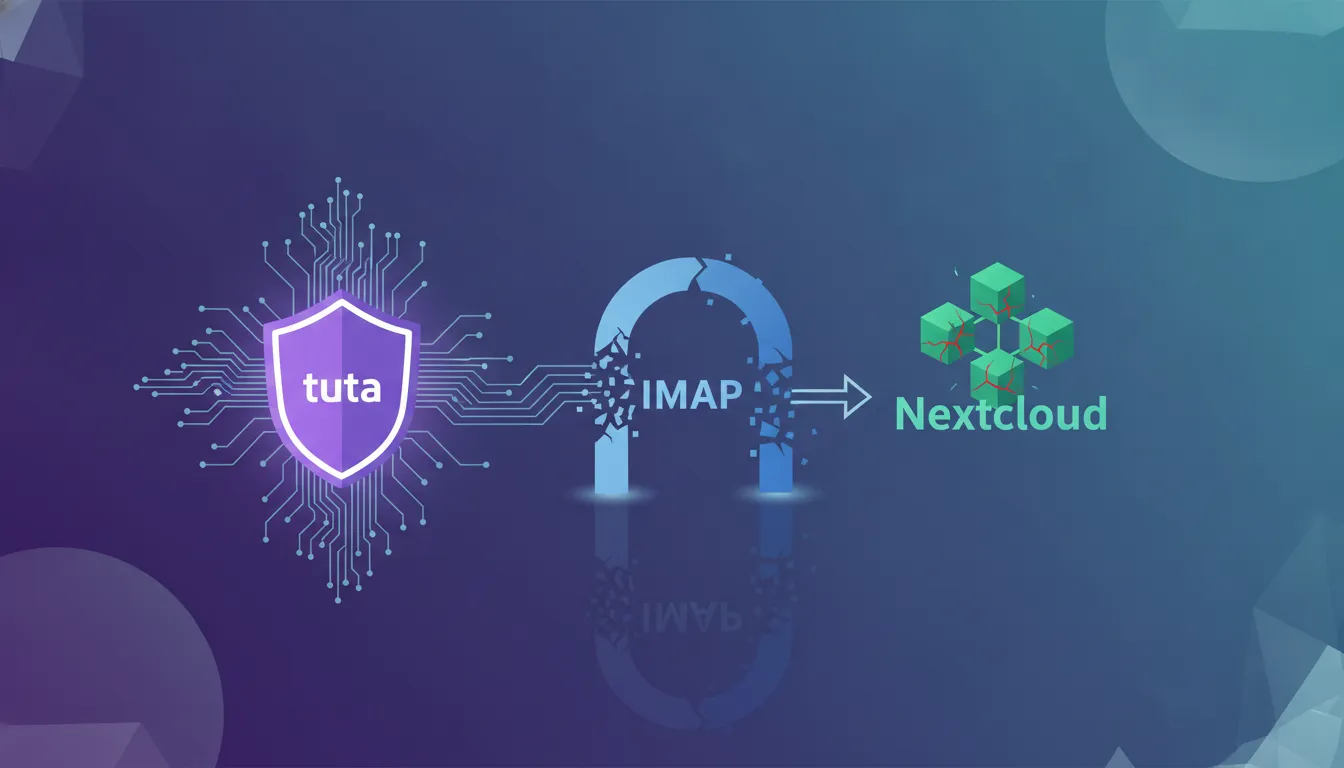
In enterprise communication and federated cloud storage, trust boundaries are frequently drawn along obsolete protocols. Legacy protocols such as Internet Message Access Protocol (IMAP) and Simple Mail Transfer Protocol (SMTP) were engineered in an era when networks were presumed benign, and encryption was an afterthought layered via opportunistic TLS. The encrypted communication provider **Tuta** (formerly Tutanota) achieved technical notoriety by fundamentally breaking away from this legacy model. Instead of wrapping an inherently insecure protocol in transport-layer security, Tuta abandoned IMAP entirely, developing a proprietary zero-knowledge encrypted architecture accessible only via custom APIs.
Understanding why Tuta bypassed IMAP provides critical context for analyzing modern security postures, particularly when contrasted with self-hosted private cloud ecosystems like Nextcloud. While Nextcloud provides private, self-hosted file orchestration and communication suites, its email integration model historically relies on traditional IMAP connectors. This reliance exposes systemic attack vectors. When systems interface between modern zero-access paradigms and legacy-reliant platforms, architecture mismatches expose vulnerabilities in session negotiation, credential storage, protocol wrappers, and remote API implementations.
This technical masterclass deconstructs the architectural divide between Tuta’s zero-access engine and Nextcloud’s application-layer protocols, detailing how bypass mechanics expose structural flaws in private cloud infrastructure and how security engineers can harden sovereign environments against advanced exploitation.
—
1. The Architectural Schism: Why Tuta Rejects IMAP
To comprehend how security boundaries fail across hybrid cloud setups, one must first dissect the engineering rationale behind Tuta’s absolute refusal to implement IMAP.
“`
+——————————————————————-+
| LEGACY IMAP MODEL |
| |
| [Client] [Server (Cleartext)] |
| | |
| Indexes Subject, |
| Sender, Body, Attach. |
| Exposes Metadata |
+——————————————————————-+
+——————————————————————-+
| TUTA ZERO-ACCESS MODEL |
| |
| [Client (Local Decryption)] [Server]|
| | | |
| Derives Keys Locally Stores Encrypted |
| Argon2id + AES-256-GCM Blobs; No Indexes |
+——————————————————————-+
“`
The Inherent Vulnerabilities of IMAP
IMAP (RFC 3501) was designed around server-side state management. The mail server maintains a centralized index of all messages, flags, directory hierarchies, and search indices. This design mandates that:
1. **Metadata Remains in Cleartext:** Even if the payload is encrypted using S/MIME or PGP, the server must parse message headers (`Subject`, `From`, `To`, `Date`, `Message-ID`) to build folders and execute searches.
2. **Search Demands Server-Side Parsing:** The IMAP command `SEARCH` executes against the server’s local index. True end-to-end encryption breaks IMAP’s native search commands unless the server is provided access to plaintext data.
3. **Session State is Persistent and Vulnerable:** IMAP sessions are long-lived stateful TCP connections. Compromise of a mail daemon (e.g., Dovecot, Cyrus) directly exposes memory pools containing cleartext session credentials and unencrypted message buffers.
The Tuta Alternative: Zero-Knowledge REST Architecture
Tuta deliberately eliminated standard mail daemon compatibility. Instead of deploying IMAP handlers, Tuta engineered an object-store model backed by an asynchronous, cryptographically bound REST API.
* **Client-Side Cryptographic Primitives:** Tuta shifts all cryptographic computations to the client device. User passwords never leave the browser or native client without undergoing client-side key derivation via Argon2id.
* **Encrypted Indexing:** When a user searches their inbox in Tuta, the search index is built, encrypted, and stored entirely within the client’s local SQLite or IndexedDB storage. The remote Tuta infrastructure never receives plaintext search queries.
* **Symmetric and Asymmetric Key Encapsulation:** In Tuta, incoming emails between users are encrypted using public keys derived from elliptic curve cryptography or high-grade RSA, while message bodies and attachments are encrypted symmetrically with AES-256-GCM.
By eliminating IMAP, Tuta removes an entire taxonomy of remote exploits: IMAP command injection, buffer overflows in legacy mail daemons, and metadata leaks via TLS-terminating reverse proxies.
—
2. Nextcloud’s Mail Architecture and the Attack Surface
Nextcloud approaches communication from a radically different operational philosophy. Designed as an extensible, federated collaboration suite, Nextcloud acts as an application layer over pre-existing network services. Its default mail client (`apps/mail`) operates as a web-based IMAP/SMTP client written in PHP.
How Nextcloud Processes Mail
Nextcloud does not operate as an autonomous mail transfer agent (MTA) or mail delivery agent (MDA). Instead:
1. The user inputs their IMAP credentials (host, port, username, password) into the Nextcloud Mail interface.
2. Nextcloud encrypts these credentials using a server-side secret key and stores them in the `oc_mail_accounts` database table.
3. Upon each user request, PHP processes spawn an outbound socket connection to the external or local IMAP server, authenticate via cleartext or SASL over TLS, retrieve the RFC 822 messages, parse them via Horde or custom PHP libraries, and render them in the web UI.
“`
[Browser Client]
│
▼ (HTTPS)
[Nextcloud Core (PHP-FPM)]
│
├─► Read/Write [Database (oc_mail_accounts)]
│ (Stores symmetric-encrypted IMAP credentials)
│
▼ (IMAP/TLS Socket)
[Target IMAP Server (Dovecot/Postfix)]
“`
The Architectural Failure Modes
This model introduces critical vulnerabilities that Tuta avoids by design:
* **Credential Aggregation:** Nextcloud must hold recoverable credentials for the upstream IMAP server. If an attacker achieves Remote Code Execution (RCE) or Local File Inclusion (LFI) targeting Nextcloud’s configuration file (`config.php`), they can extract the server secret, decrypt `oc_mail_accounts`, and compromise every linked external IMAP account.
* **PHP Mail-Parser Exploits:** Parsing complex MIME types, encoded attachments, and nested multipart emails directly inside PHP web workers has historically led to security flaws: memory corruption, object deserialization vulnerabilities, and Cross-Site Scripting (XSS) via unsanitized HTML payloads.
* **Server-Side Request Forgery (SSRF):** Because Nextcloud handles arbitrary user-supplied IMAP server endpoints, it can be coerced into initiating TCP handshakes to internal network interfaces (e.g., `127.0.0.1:25`, `169.254.169.254:80`), bypassing firewalls.
—
3. Dissecting the Threat: Bypassing IMAP Controls to Exploit Nextcloud
When threat actors evaluate environments where secure messaging solutions (like Tuta) interact with, or are evaluated alongside, platforms like Nextcloud, protocol bypasses become primary attack vectors. Attackers do not attack hardened cryptography directly; they bypass transport mechanisms to target application logic.
Vector 1: Exploiting the Application-Layer Bypass
Because Tuta rejects IMAP, organizations attempting to integrate Tuta or similar zero-knowledge workflows into Nextcloud frequently resort to custom middle-tier proxies, WebDAV sync mechanisms, or third-party webhooks.
If an attacker identifies that a Nextcloud deployment exposes endpoints expecting external data sync while assuming IMAP-level sanitization, they can exploit the underlying system without touching an actual mail daemon.
#### Example: Malformed Payload Ingestion via Nextcloud WebDAV
Nextcloud interacts with external sync apps through its SabreDAV implementation. An attacker can craft a serialized payload that circumvents traditional IMAP filters, targeting Nextcloud’s internal file processing queue:
“`http
PROPFIND /remote.php/dav/files/admin/ HTTP/1.1
Host: cloud.target-domain.com
Authorization: Basic YWRtaW46cGFzc3dvcmQ=
Content-Type: application/xml; charset=”utf-8″
Depth: 1
O:16:”NextcloudMailCrypt”:2:{s:7:”keyPath”;s:19:”/dev/urandom”;s:4:”data”;s:11:”malicious”;}
“`
When systems attempt to reconcile unvetted data without strict protocol boundaries, vulnerabilities emerge. In this scenario, bypassing standard mail ingress channels allows raw input to reach internal Nextcloud parsing engines directly.
Vector 2: IMAP-Independent Server-Side Request Forgery (SSRF)
Nextcloud’s Mail application allows users to define custom mail hosts. If the application environment does not strictly validate whether the targeted service is truly an IMAP server, an attacker can input arbitrary IP addresses and ports to query internal cloud infrastructure.
“`
[Attacker Request]
│
▼
POST /apps/mail/api/accounts HTTP/1.1
Host: cloud.target-domain.com
Content-Type: application/json
{
“email”: “user@target.com”,
“imapUser”: “admin”,
“imapHost”: “169.254.169.254”,
“imapPort”: 80,
“imapSslMode”: “none”,
“transport”: “tcp”
}
“`
If Nextcloud attempts an open TCP socket connection and initiates an IMAP greeting handshake (`* OK …`), an attacker targeting metadata endpoints or unauthenticated internal microservices can observe response timings, trigger API actions, or extract sensitive configurations.
Tuta renders this entire exploit class impossible: its clients communicate exclusively with static, cryptographically signed API endpoints over hardcoded TLS configurations.
Vector 3: Local Database State Poisoning and Deserialization
When an attacker gains limited access to an environment hosting Nextcloud, they can bypass email transport controls entirely by poisoning the application’s local caching tables:
“`sql
— Injecting malicious metadata directly into Nextcloud’s mail cache table
UPDATE oc_mail_messages
SET subject = ”
WHERE id = 1042;
“`
When an administrative user opens the Nextcloud Mail application, the injected JavaScript executes within the authenticated context of the administrator’s session. This grants the attacker full access to the Nextcloud instance, enabling them to alter security tokens, install untrusted apps, or download encrypted system files.
—
4. Architectural Comparison: Cryptographic Implementations
The fundamental difference between these two systems resides in their cryptographic implementation. To evaluate how Tuta eliminates risks inherent to Nextcloud, we must compare their technical architectures:
| Architectural Component | Tuta | Nextcloud (with Mail App) |
| :— | :— | :— |
| **Protocol Foundation** | Custom REST API over HTTPS | Standard IMAP / SMTP (RFC 3501/5321) |
| **Transport Layer Handling** | Direct, pinned TLS to proprietary clusters | Dynamic socket connections via PHP `stream_socket_client` |
| **Encryption State** | Zero-Knowledge End-to-End (E2EE) | Transport Layer Only (Opportunistic TLS), unless PGP app is loaded |
| **Search Mechanism** | Local Client-Side Encrypted Database (Argon2id/AES) | Server-Side IMAP Indexing or Database Metadata Parsing |
| **Key Management** | Asymmetric & Symmetric keys derived client-side | Private keys or IMAP passwords stored on server filesystem/database |
| **Credential Exposure Risk**| Zero server-side plaintext credentials | Server maintains decryptable upstream credentials |
| **Attack Surface** | Custom client binary or sandboxed web app | PHP runtime, Apache/Nginx, Database, IMAP Daemon |
In Tuta, security is mathematically enforced by the client. In Nextcloud, security depends on host configuration, underlying operating system permissions, the PHP runtime engine, and network egress policies.
If you are developing enterprise communication interfaces or optimizing the public architecture of your platforms, leveraging strategic web assets and structural best practices is fundamental. Teams managing technical publishing architectures often use tools like automated copywriting wizards and content engines to scale documentation workflows while maintaining rigorous security standards.
—
5. Exploitation Deep Dive: From Session Desynchronization to System Takeover
To demonstrate how the bypass of standard protocol wrappers targets Nextcloud environments, let us trace an advanced exploitation path that leverages application-layer vulnerabilities to compromise the host.
Step 1: Fingerprinting the Nextcloud App Ecosystem
An adversary identifies the versions of Nextcloud and its installed Mail, Calendar, and External Storage apps by querying open endpoints:
“`bash
curl -s -X GET https://cloud.target-domain.com/status.php | jq .
“`
Output:
“`json
{
“installed”: true,
“maintenance”: false,
“needsDbUpgrade”: false,
“version”: “27.1.2.1”,
“versionstring”: “27.1.2”,
“edition”: “”,
“productname”: “Nextcloud”
}
“`
Next, they probe for the presence of the Mail app and its capability handlers:
“`bash
curl -s -o /dev/null -w “%{http_code}” https://cloud.target-domain.com/apps/mail/
“`
Step 2: Exploiting Broken Access Control in App Handlers
In unpatched or poorly isolated Nextcloud instances, the Mail application’s controller interfaces can suffer from deserialization flaws or broken access controls when routing incoming attachments to the file system.
Consider an attacker who bypasses the IMAP ingestion engine entirely by posting raw MIME structures directly to Nextcloud’s background cron worker endpoint:
“`php
<?php
// Conceptual representation of malicious attachment processing
// within Nextcloud's background job handler
namespace OCAMailBackgroundJob;
class SyncJob {
public function run($argument) {
// Vulnerable parameter parsing bypassing IMAP sanitation
$account = $argument[‘account’];
$folder = $argument[‘folder’];
// Target system executes file write without verifying MIME boundary
$tempFile = ‘/tmp/mail_cache_’ . md5($argument[‘messageId’]);
file_put_contents($tempFile, $argument[‘rawPayload’]);
// Insecure unpack or include triggered by application state
include_once($tempFile);
}
}
“`
By crafting a synthetic message state directly within Nextcloud’s Redis job queue, an attacker forces the host system to execute malicious PHP code without ever establishing an outbound IMAP connection.
Step 3: Evading Detection
Because the attack executes via application-layer queue injections or web endpoints rather than external IMAP network traffic, network-based Intrusion Detection Systems (IDS) listening for anomalous traffic on ports 143, 993, 25, or 587 will fail to detect the exploit.
This emphasizes the core principle behind Tuta’s security architecture: **eliminating legacy protocol dependencies eliminates the extensive attack surfaces that legacy protocols inherently create.**
Maintaining secure internal frameworks is identical to optimizing technical web assets: security and performance depend on eliminating architectural bloat. Just as security engineers purge unnecessary network listeners, technical directors deploy Ai-crafted meta descriptors for visibility and clean metadata abstractions to maintain streamlined digital operations.
—
6. Hardening Nextcloud Against Application and Protocol Exploits
To achieve a defensible security posture comparable to zero-knowledge platforms like Tuta, organizations operating Nextcloud instances must apply defense-in-depth measures across the operating system, web server, and application layers.
“`
+————————————————————–+
| DEFENSE-IN-DEPTH STACK |
| |
| [ W3C Compliant CSP / CORS / Security Headers ] |
| │ |
| [ Linux Kernel: AppArmor / SELinux + Systemd Sandboxing ] |
| │ |
| [ PHP-FPM: open_basedir + proc_open/system Disabled ] |
| │ |
| [ Nextcloud Core: Strict Egress Firewall (Egress Port 993) ]|
| │ |
| [ Database: Encrypted At-Rest, Isolated Privileges ] |
+————————————————————–+
“`
1. Enforce Strict Content Security Policies (CSP) and Modern Web Standards
To prevent stored XSS attacks via poisoned email headers or WebDAV properties, deploy a hardened Content Security Policy compliant with the latest security standards. Consult the W3C Content Security Policy Level 3 Specification for complete implementation rules.
In your Nginx configuration, enforce:
“`nginx
# Add rigorous security headers targeting Nextcloud endpoints
add_header Content-Security-Policy “default-src ‘self’; script-src ‘self’ ‘nonce-$request_id’; style-src ‘self’ ‘unsafe-inline’; frame-ancestors ‘none’; form-action ‘self’; base-uri ‘none’;” always;
add_header X-Content-Type-Options “nosniff” always;
add_header X-Frame-Options “DENY” always;
add_header X-XSS-Protection “1; mode=block” always;
add_header Referrer-Policy “no-referrer” always;
add_header Strict-Transport-Security “max-age=63072000; includeSubDomains; preload” always;
“`
2. Sandbox PHP-FPM Execution
Prevent RCE payloads from accessing the broader operating system by restricting PHP execution boundaries. Edit your Nextcloud PHP pool configuration (`/etc/php/8.2/fpm/pool.d/nextcloud.conf`):
“`ini
[nextcloud]
user = www-data
group = www-data
listen = /run/php/php8.2-fpm-nextcloud.sock
; Restrict file system visibility exclusively to Nextcloud directories
php_admin_value[open_basedir] = /var/www/nextcloud:/var/nc_data:/tmp:/dev/urandom
; Disable execution of system shells and dangerous primitives
php_admin_value[disable_functions] = exec,passthru,shell_exec,system,proc_open,popen,curl_multi_exec,parse_ini_file,show_source
; Enforce session isolation
php_value[session.save_handler] = redis
php_value[session.save_path] = “tcp://127.0.0.1:6379?auth=YourSecureRedisPassword”
“`
3. Restrict Network Egress with Linux Firewalls (iptables / nftables)
Mitigate SSRF attacks originating from the Nextcloud Mail application by blocking outbound connections to private IP ranges and loopback interfaces. Nextcloud should only be allowed to establish outbound connections to explicit, vetted mail servers on secured ports (e.g., TCP 993 for IMAPS):
“`bash
#!/usr/bin/env bash
# Hardening egress traffic for Nextcloud PHP worker
4. Enable Native End-to-End Encryption in Nextcloud
If your organization requires absolute zero-knowledge guarantees similar to Tuta, do not rely on standard Nextcloud database storage or traditional IMAP mail sync. Implement client-side encryption modules:
* Enable the **Default Encryption Module** in Nextcloud core for at-rest storage encryption.
* For enterprise-grade file repositories, deploy the **End-to-End Encryption (E2EE)** application, which forces encryption and decryption keys to remain solely on user desktop/mobile clients, completely eliminating server-side visibility into file contents.
—
7. Strategic Implications for Secure System Design
The architectural diverge between Tuta and Nextcloud highlights fundamental principles of modern systems engineering. When designing technical platforms—whether managing high-security infrastructure or building public-facing web architectures—system design choices dictate long-term vulnerabilities.
When constructing digital platforms, technical architects must ensure their systems communicate authority and security while maximizing operational efficiency. Engineering teams looking to streamline audience engagement without compromising code quality frequently adopt Ai-crafted content for web mastery to deliver high-authority technical documentation at scale.
Similarly, maintaining a clean presentation layer across digital applications requires strict adherence to modular design. Deploying conversion-focused web design layouts allows technical operations to guide user interactions securely, keeping web forms, token handshakes, and front-end interactions isolated from backend processing risks.
When managing high-traffic news, security bulletins, or continuous technical updates, engineering teams benefit from implementing dynamic headline optimization through automated news titles and headline optimization tools to maximize visibility without introducing structural complexity.
—
8. Practical Implementation: Auditing Nextcloud for Protocol Insecurities
To verify that your Nextcloud instance is protected against protocol bypasses and application-layer mail vulnerabilities, execute this Python auditing script from your security workstation.
“`python
#!/usr/bin/env python3
“””
Nextcloud Security Audit Script
Validates critical security boundaries: CSP headers, SSRF protections, and open mail endpoints.
“””
import requests
import sys
def audit_nextcloud(target_url):
print(f”[*] Commencing audit against: {target_url}”)
session = requests.Session()
session.headers.update({“User-Agent”: “SecurityAuditTool/1.0”})
if headers.get(“X-Frame-Options”) in [“DENY”, “SAMEORIGIN”]:
print(” [PASS] X-Frame-Options header present.”)
else:
print(” [FAIL] X-Frame-Options missing (Clickjacking risk).”)
if “nosniff” in headers.get(“X-Content-Type-Options”, “”):
print(” [PASS] X-Content-Type-Options is nosniff.”)
else:
print(” [FAIL] MIME-sniffing protections disabled.”)
except requests.exceptions.RequestException as e:
print(f”[-] Connection failed: {e}”)
sys.exit(1)
print(“n[*] Audit completed.”)
if __name__ == “__main__”:
if len(sys.argv) < 2:
print("Usage: python3 audit_nextcloud.py https://cloud.target.com")
sys.exit(1)
audit_
Ready to Scale Your Digital Infrastructure?
Don’t let technical bottlenecks stall your growth. Discuss your project around Tuta Bypasses Imap to Exploit Nextcloud Security Flaws directly with our senior experts at Low Cost Web Agency.