
Search engine algorithms reward relevance, structural depth, and distinct information value. For digital enterprises scaling their online footprints, manual content creation represents an operational bottleneck. Relying entirely on manual copywriting restricts publishing velocity, inflates customer acquisition costs, and complicates the systematic optimization required for modern enterprise SEO.
Deploying automated copywriting systems fundamentally alters this dynamic. However, executing this strategy successfully demands more than sending primitive, single-turn prompts into public consumer LLMs (Large Language Models). Scaled search dominance requires an engineered approach to **AI writing**: establishing programmatic data pipelines, using Retrieval-Augmented Generation (RAG), mapping entities semantically, and running rigorous automated editorial quality checks.
Transforming automated copywriting from a generic text generator into an enterprise-grade visibility asset requires direct control over the technical architecture underlying algorithmic content production.
—
The Mechanics of Automated Copywriting: Beyond Basic Prompting
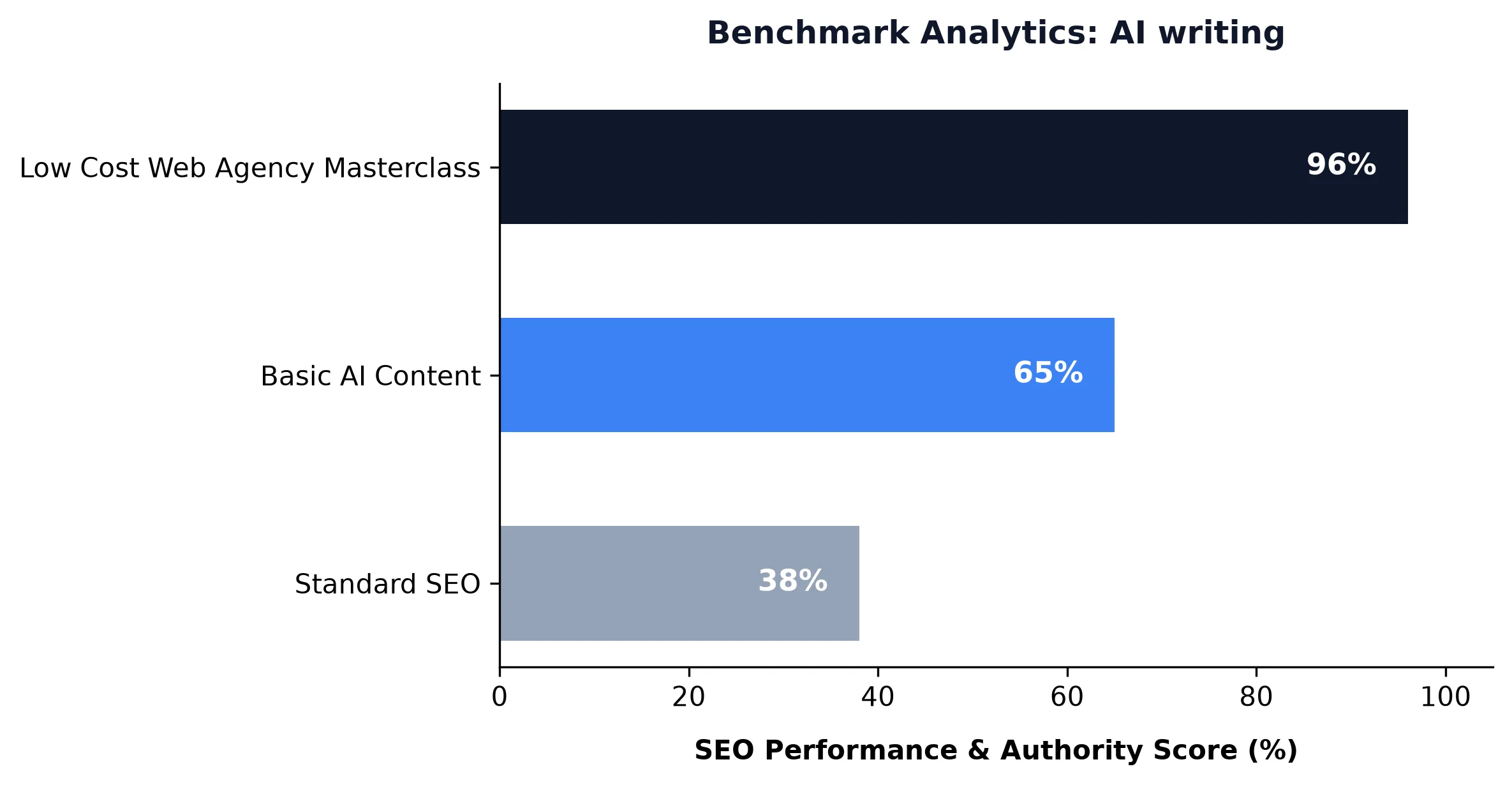
Natural language processing models operate on statistical next-token prediction. When exposed to an input sequence, the model queries its transformer attention heads to calculate the highest probability tokens to follow. While this mechanism generates syntactically fluent prose, it creates two major risks for search indexing: generic platitudes and unverified hallucinations.
Modern search engines analyze text using sophisticated natural language understanding (NLU) layers, evaluating content on semantic entity salience and information gain. Content that merely averages existing web documents without adding fresh perspectives, data points, or unique structural utility fails modern ranking criteria.
“`
[Raw Search Queries & Corpus]
│
▼
[Vector Database / Semantic Search (Embeddings)]
│
▼
[Context Injection via RAG Architecture]
│
▼
[LLM Processing (Parameter-Constrained Prompts)]
│
▼
[Post-Processing: NLP Filtering, Entity Injection & Schema Markup]
│
▼
[Headless CMS Production / Indexation]
“`
To secure top organic positions, your AI writing pipeline must combine pre-trained foundational models with private data sources and structured semantic frameworks.
Controlling Entropy and Token Distribution
* **Temperature Modulation:** Lower generation temperatures ($0.2 – 0.4$) for factual documentation, technical product descriptions, and metadata; calibrate to moderate levels ($0.6 – 0.7$) for top-of-funnel educational articles to allow natural syntactic variety without factual drift.
* **Frequency and Presence Penalties:** Apply fine-tuned presence penalties within API configurations to reduce repetitive phrasing, corporate jargon, and model-specific filler text.
* **Top-P (Nucleus Sampling):** Restrict token candidates to a cumulative probability threshold, ensuring vocabulary selection remains authoritative and contextually precise.
Executing Ai-powered content magic demands moving past default chat interfaces. It requires treating language models as execution runtimes governed by explicit constraints, deterministic schemas, and verifiable source data.
—
Architecting Retrieval-Augmented Generation (RAG) for SEO Authority
To produce content that ranks sustainably, models must reference authoritative data rather than relying entirely on frozen parametric memory. Retrieval-Augmented Generation (RAG) bridges this gap by querying an external vector database before generating a single sentence.
“`python
# Conceptual architecture for an enterprise programmatic RAG pipeline
import openai
from qdrant_client import QdrantClient
def generate_contextual_node(query_entity, vector_client, collection_name):
# 1. Fetch dense vector embeddings for query
query_vector = openai.Embedding.create(
input=query_entity,
model=”text-embedding-3-large”
)[‘data’][0][’embedding’]
# 2. Extract domain-specific technical documentation
hits = vector_client.search(
collection_name=collection_name,
query_vector=query_vector,
limit=5
)
context_data = “n”.join([hit.payload[‘text’] for hit in hits])
# 3. Synthesize via explicit system parameter bounds
system_instruction = (
“You are an enterprise technical writer. Use ONLY the verified context below. ”
“Eliminate corporate cliches. Maintain concise, dense technical prose.”
)
response = openai.ChatCompletion.create(
model=”gpt-4o”,
temperature=0.3,
messages=[
{“role”: “system”, “content”: system_instruction},
{“role”: “user”, “content”: f”Context: {context_data}nnTask: Draft technical analysis for: {query_entity}”}
]
)
return response.choices[0].message[‘content’]
“`
Knowledge Graph Integration and Entity Salience
Search engines analyze documents through an entity-first lens. Systems like Google’s Knowledge Graph dissect web pages into discrete entities (people, places, concepts, technologies) and map the semantic relationships between them.
1. **Extract Primary and Secondary Entities:** Pull the definitive Wikidata, Wikipedia, or schema IDs of your target subject matter before drafting.
2. **Map Semantic Triples:** Structure your content around subject-predicate-object triples (e.g., `[Headless CMS] -> [decouples] -> [presentation layer]`).
3. **Optimize Entity Density:** Avoid keyword stuffing. Instead, maximize entity co-occurrence by integrating logically associated technical terminology throughout each section.
By pairing RAG architecture with entity-based knowledge graphs, your automated AI writing workflows yield content that Search Engine Result Pages (SERPs) evaluate as authoritative, original, and deeply informative.
—
SERP Alignment, Search Intent, and Information Gain
Google’s updated quality evaluator guidelines and patent filings reveal an active search engine pivot: prioritizing **Information Gain**. If an automated article covers the exact same subtopics as the top five ranking pages using identical rhetoric, search engines have no incentive to index or rank it.
According to Google Search Central documentation on helpful content, systems prioritize original reporting, unique structural presentation, and value that goes beyond repeating established facts.
Algorithmic Intent Parsing
Every query represents an explicit point along the intent spectrum: informational, commercial investigation, transactional, or navigational. Automated systems must dynamically align content structure with this underlying intent:
| Search Intent | Model Configuration Focus | Core Output Requirements | UI/UX Output Architecture |
| :— | :— | :— | :— |
| **Informational** | Low Temperature ($0.3$), Dense Context Injection | Precise definitions, step-by-step logic, technical schemas | Structured H2/H3 headers, technical diagrams, clear callout blocks |
| **Commercial** | Moderate Temperature ($0.5$), Comparative Datasets | Feature evaluation, edge-case analysis, quantitative benchmarks | Sortable data matrices, transparent pros/cons, verified specifications |
| **Transactional** | Constrained Prompts, Conversion Optimization Focus | Friction-free specifications, trust signals, direct value delivery | Prominent CTAs, bulleted deliverables, verified guarantees |
Systematic Title and Hook Generation
Engaging headlines dictate initial SERP click-through rates (CTR). Even structurally flawless content fails if its headline blends into the search results. Using dedicated prompt workflows for Ai-created headlines lets marketing teams test dozens of high-CTR, clickbait-free titles at scale. These titles match technical search intent while generating the semantic variety needed to win the click.
“`
Prompt Concept for High-CTR Titles:
“Generate 10 H1 titles for an article detailing [Topic].
Format: [Clear Action Verb] + [Specific Value Metric] + [Technical Target].
Zero marketing jargon. Maximum 60 characters. Avoid hyperbolic assertions.”
“`
—
Dynamic Metadata, Schema Serialization, and Crawl Efficiency
Search engine visibility depends on both on-page text and programmatic communication with search spiders. An automated publishing engine must dynamically produce descriptive metadata and valid JSON-LD schema alongside the core article body.
Dynamic Meta Extraction
Meta descriptions act as your secondary organic advertisement. Rather than letting search engines pull random text fragments from your page, use modular agents like Ai-crafted meta descriptors. These tools summarize primary entities, state direct value propositions, and stay within strict 155-character limits.
Structured Schema Markup Injection
Every piece of programmatic copy should emerge from the AI pipeline with corresponding, syntax-validated schema ready for the DOM.
“`json
{
“@context”: “https://schema.org”,
“@type”: “TechArticle”,
“headline”: “Algorithmic Scale: Engineering Search Visibility via Advanced AI Writing Pipelines”,
“description”: “A technical masterclass on programmatic, automated copywriting and AI writing architectures to scale organic visibility and semantic search compliance.”,
“dependencies”: “Vector Databases, LLM APIs, Python, Semantic Triples”,
“proficiencyLevel”: “Advanced”,
“author”: {
“@type”: “Organization”,
“name”: “Low Cost Web Agency”
}
}
“`
Serializing `TechArticle`, `FAQPage`, or `HowTo` markup directly within the generation pipeline helps search spiders parse page structures quickly. This structural clarity boosts eligibility for rich snippets and expands footprint across AI-driven search experiences.
—
The Human-in-the-Loop (HITL) Validation Framework
Automating your content production does not mean abandoning human editorial standards. Unmonitored, fully autonomous AI writing pipelines often experience context drift, outdated assertions, and stylistic degradation over time.
Deploying an editorial validation gate between the generation phase and production deployment ensures your output consistently matches elite publishing standards:
“`
[Raw AI Generation]
│
▼
[Automated NLP Heuristics Check] ──(Fails)──► [Re-Prompting Engine]
│ (Passes)
▼
[Domain Expert Review (HITL)]
├─ Fact Verification
├─ Proprietary Insight Injection
└─ Tone / Voice Normalization
│
▼
[Final Publishing Pipeline]
“`
1. Automated NLP Heuristics Check
Before human editors review a draft, run the text through programmatic linting tools:
* **Perplexity and Burstiness Analysis:** Low perplexity across uniform paragraph lengths signals predictable text generation. Inject variation by forcing sentence lengths to alternate between short statements and detailed compound clauses.
* **Buzzword and Jargon Scrubbing:** Run automated regex filters to purge overused platform vocabulary, fluff phrases, and passive filler words.
* **Readability and Grade-Level Verification:** Confirm the draft matches your target audience’s technical expectations (e.g., Flesch-Kincaid Grade 11–13 for enterprise software buyers).
2. Strategic Value-Add Verification
Human subject matter experts should focus their efforts where LLMs hit their limits:
* Adding original research, proprietary performance benchmarks, or real case metrics.
* Embedding hands-on troubleshooting tips and field-tested advice.
* Adjusting the structural point of view to align directly with brand perspective.
This hybrid workflow—combining high-speed generative text with rigorous human review—embodies modern best practices for Ai-crafted content: the future of seo and web design mastery.
—
Aligning Copywriting with Modern Web Design Architecture
Even the most thorough content fails to rank if the underlying web infrastructure is slow, unstable, or difficult to navigate. Modern search engines assess page experience using Core Web Vitals (Largest Contentful Paint, Interaction to Next Paint, Cumulative Layout Shift).
Your written content works as an integrated component of the overall user experience. High-performing automated systems pair optimized copy with high-converting, ai-powered layouts that convert visits into sales.
“`
┌──────────────────────────────────────────────────────────┐
│ Primary Entity H1 (Pre-rendered for LCP optimization) │
├────────────────────────────┬─────────────────────────────┤
│ Core Summary Callout │ Sticky Dynamic Conversion │
│ – Key Takeaways (Bullet 1) │ Component (Lead Capture) │
│ – Key Takeaways (Bullet 2) │ │
├────────────────────────────┴─────────────────────────────┤
│ Structured Informational Body (Lazy-loaded Sub-sections) │
│ – Semantic H2 Subheadings │
│ – Rich JSON-LD Embedded in │
│ – Compressed Vector Visual Assets │
└──────────────────────────────────────────────────────────┘
“`
Strategic Technical Layout Best Practices
* **Server-Side Rendering (SSR):** Never render primary AI-generated text using client-side JavaScript execution. Search engine crawlers can miss dynamically fetched text blocks. Pre-render content on the server or output static pages via incremental static regeneration (ISR).
* **Layout Shift Elimination:** Hardcode explicit height and width parameters on all dynamically injected media, diagrams, and sidebars to prevent layout movement during hydration.
* **Progressive Context Parsing:** Place critical answers and primary entity definitions directly near the top of the page. This structural clarity supports both skimming visitors and search engines targeting quick snippet extractions.
—
Step-by-Step Implementation Blueprint: Building an Automated AI Writing Engine
Here is the operational roadmap for engineering an automated, high-visibility content production system from the ground up:
“`
[Phase 1: Research] ──► [Phase 2: Orchestration] ──► [Phase 3: QA & Deploy]
• Keyword Clustering • Dynamic Prompt Chaining • Schema Validation
• Entity Extraction • RAG Context Injection • Technical CMS Push
“`
Phase 1: Research, Scraping, and Entity Clustering
1. **Semantic Clustering:** Export target queries from search intelligence platforms. Group keywords by shared Search Engine Result Page patterns rather than simple lexical matches.
2. **Top-Rank Analysis:** Programmatically crawl the top 5 ranking URLs for each keyword group. Run entity extraction libraries (such as SpaCy) across the body copy to pull all recurring concepts, heading patterns, and relevant schema types.
3. **Identify Content Gaps:** Determine which technical questions, edge cases, or current data points the competing URLs miss. Feed these identified gaps straight into your generation pipeline.
Phase 2: Building the Generation Engine
1. **System-Level Instructions:** Build explicit personas. Instruct the engine to write from the perspective of a senior technical practitioner, with direct commands barring marketing fluff, clichés, and vague generalities.
2. **Prompt Chaining:** Break long-form production down into focused, modular steps:
* *Step A:* Generate a logically sequenced outline organized by search intent.
* *Step B:* Draft each individual section while injecting dedicated context blocks.
* *Step C:* Generate contextual internal links pointing back to related hub pages.
* *Step D:* Produce metadata, FAQs, and JSON-LD schema.
3. **API Execution:** Query your chosen model with explicit temperature, presence, and token settings calibrated for clear, factual exposition.
Phase 3: Validation, Formatting, and Production
1. **Regex Scrubbing:** Strip recurring AI transition words and phrases (“in conclusion,” “crucial to remember,” “delving deeper”).
2. **Schema Validation:** Test generated JSON-LD blocks against official schema specifications to prevent formatting errors.
3. **CMS Integration:** Deploy validated content into your headless CMS via REST or GraphQL APIs, setting the post status to `Pending Review` for quick human verification.
—
Auditing and Tracking Programmatic Performance
Once your automated system is live and publishing content, you need to track how search engines index and rank your pages.
“`
Publishing Event ──► Log File Analysis ──► Search Console Audit ──► Optimization
“`
1. Server Log File Audits
Monitor crawler access logs to confirm search spiders discover and process your programmatic pages efficiently:
* **Track Crawl Frequency:** Verify that bot visits expand proportionally as you publish new URLs.
* **Eliminate 4xx/5xx Errors:** Catch server configuration problems, incorrect canonical links, or broken internal pathways before they harm crawl budgets.
* **Monitor Response Times:** Ensure server response latency stays below 300ms so crawlers can index newly launched URLs without delay.
2. Search Console Performance Indicators
* **Indexing Velocity:** Track the time between initial publication and inclusion within the primary search index. Significant delays indicate thin content signals, internal linking bottlenecks, or domain authority constraints.
* **Query Expansion:** Check if single programmatic URLs begin capturing impressions across dozens of long-tail keyword variations. This broad visibility shows strong entity association and thorough topic coverage.
* **Click-Through Rate (CTR) Analysis:** Identify pages earning strong impressions but low click volume. Optimize their headlines and meta descriptions to improve SERP performance.
—
Frequently Asked Questions
Will search engines penalize websites for publishing AI writing?
Search engines do not penalize content simply because it was produced using AI tools. Their ranking systems prioritize value, technical depth, and factual accuracy over generation methods. However, sites will see performance drops if they deploy low-effort, unvetted copy that lacks unique perspectives, contains factual errors, or shows clear signs of keyword manipulation.
How does automated copywriting differ from programmatic SEO?
Programmatic SEO focuses on creating templated web pages at scale using structured databases (e.g., building 500 city-specific service pages from a single template). Automated copywriting uses language models to generate unique, long-form prose and deep analysis. Blending both strategies lets teams build programmatic page structures backed by high-quality, context-aware written content.
What is the most effective approach for preventing hallucinations in AI content?
The most reliable safeguard is implementing Retrieval-Augmented Generation (RAG). By supplying the language model with verified, source-specific data at query time and instructing it to draw answers exclusively from that context, you significantly reduce factual drift and keep outputs grounded in reality.
How many articles can an automated pipeline safely publish each week?
There is no fixed limit. Search engines scale crawl budgets based on a website’s overall authority, hosting performance, and publishing history. A new domain should start slowly (e.g., 5 to 15 well-vetted, comprehensive articles weekly) while establishing crawl trust. Established domains with high authority can publish hundreds of programmatic pages every week without issue, provided the technical infrastructure and content quality remain sound.
—
The Path to Enterprise Scalability
Automated copywriting has outgrown its origin as a novelty writing assistant. When built around retrieval-augmented architectures, semantic entity mapping, and systematic editorial quality gates, **AI writing** serves as a core engine for long-term organic growth.
Scaling web visibility requires treating content as an integrated software system. By removing operational bottlenecks, enforcing technical publishing standards, and aligning closely with search intent, modern teams can publish high-value, rank-ready content at a pace manual teams simply cannot match. Implement these structured pipelines to claim top organic rankings across your target markets.
Ready to Scale Your Digital Infrastructure?
Don’t let technical bottlenecks stall your growth. Discuss your project around Ai-powered content magic: instantly boost your website’s visibility with automated copywriting wizards directly with our senior experts at Low Cost Web Agency.