
Imagine opening a beautiful physical boutique on the busiest avenue in your city. Every day, thousands of people stroll through the front doors. They admire the decor, smell the scented candles, browse through your clothing racks, ask you what time the shop closes, and then walk right back out without spending a single penny.
At the end of the month, your store looks wildly popular on paper because foot traffic is through the roof. Yet, your cash register is empty, your inventory is gathering dust, and the rent is due.
In the online world, this exact nightmare happens to thousands of business owners every single day.
Many entrepreneurs invest significant time and money into search engine optimization (SEO), celebrating every time their website traffic graph shoots upward. But when they check their bank account, nothing has changed. The reason for this heartbreak is simple: traffic does not equal revenue.
If you want your website to generate steady sales, qualified leads, and loyal clients, you need a smart Digital Strategy centered on understanding search intent. You must know how to distinguish the people who are merely looking around from the people standing in line with their credit cards in hand.
In this masterclass, we will demystify the four essential types of SEO keywords, explore the psychology behind every search query, and show you exactly how to build a high-converting website that turns casual visitors into paying customers.
What Is Search Intent, and Why Is It the Backbone of Your Digital Strategy?
Before we look at the specific keyword categories, we must understand the engine that drives modern search engines: Search Intent.
Whenever a person opens Google, Bing, or an AI assistant and types a phrase into the search box, they are not just typing arbitrary words. They are trying to solve a specific problem, answer a burning question, or fulfill an immediate need. Search intent is simply the underlying goal behind that Google search.
Years ago, search engines were relatively primitive. If you repeated a specific keyword twenty times on a webpage, Google would rank your page near the top, regardless of whether your content actually satisfied the human reader. Those days are long gone.
Today, search algorithms are sophisticated enough to evaluate whether your page actually delivers what the user wanted. If someone searches for a quick answer and lands on a hard-sell sales pitch, they will immediately click the “Back” button. When search engines notice people bouncing away from your site in frustration, your rankings will drop like a stone.
A winning Digital Strategy does not focus on tricking search engines into sending random visitors to your site. Instead, it pairs the right type of content with the right type of keyword, meeting your potential customers at the exact stage they occupy in their buying journey.
The 4 Types of SEO Keywords Every Entrepreneur Must Know
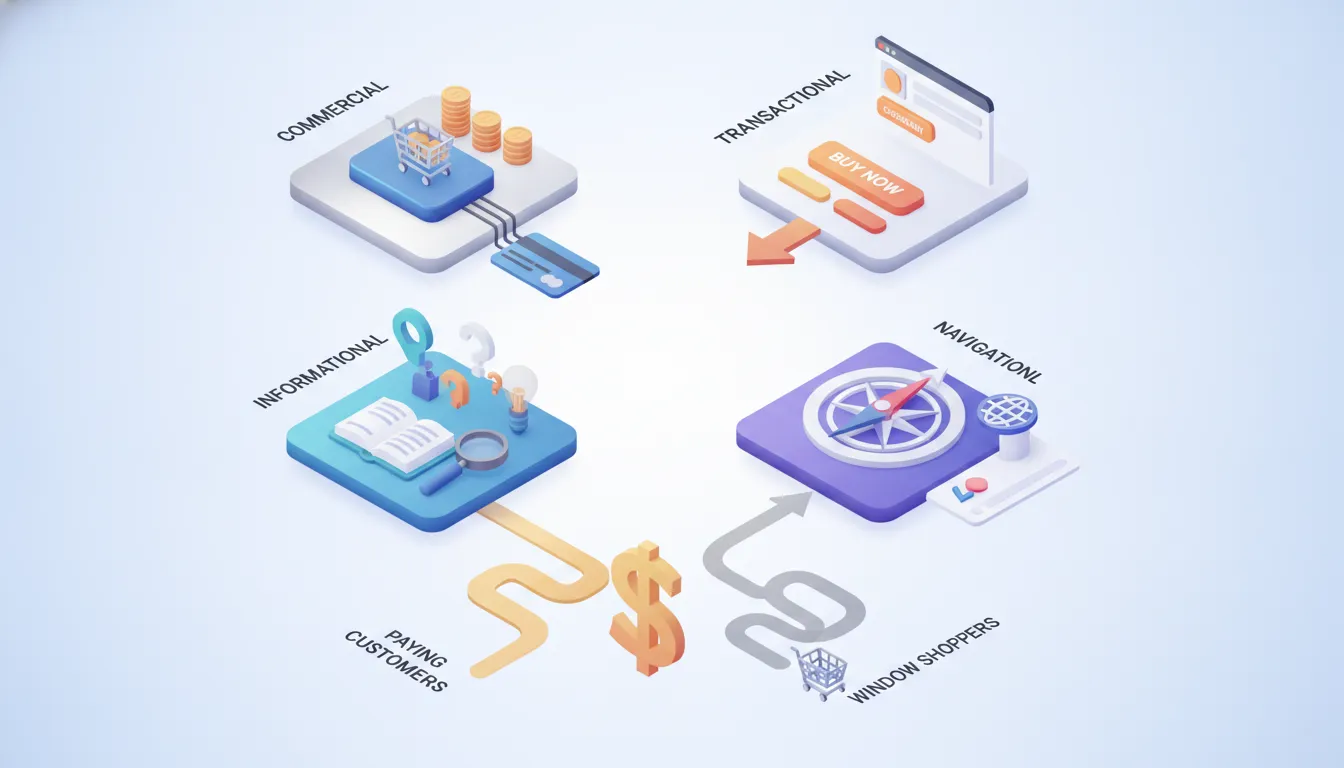
Every search term entered into a search bar falls into one of four distinct categories:
- Informational Keywords (The Curious Researchers)
- Navigational Keywords (The Destination Seekers)
- Commercial Keywords (The Careful Evaluators)
- Transactional Keywords (The Ready-to-Buy Decision Makers)
Let us examine each category in depth so you can design content that attracts visitors who are actually ready to do business with you.
1. Informational Keywords: The Curious Researchers
Informational keywords are used by people who are seeking knowledge, education, or answers to a specific question. These users are experiencing a problem or a curiosity, but they are not necessarily looking to buy a product or hire a service at this exact moment.
In our physical store analogy, these are the people who walk into a hardware store asking, “Why is my kitchen sink making that strange whistling sound?” They do not have their wallet out; they just want to know how plumbing works.
Common Identifiers for Informational Searches:
- Words such as how to, what is, why does, guide, tutorial, ideas, and tips.
- Questions ending in a question mark.
- Broad topic overviews (e.g., “coffee roasting history” or “types of roof shingles”).
Real-World Examples:
- “What is digital strategy?”
- “How to change a flat bicycle tire”
- “Why do house plants get yellow leaves?”
- “Best exercises for lower back pain at home”
How to Handle Informational Keywords in Your Business
Informational searches make up roughly 80% of all searches conducted on the web. It is very easy to write hundreds of blog posts targeting informational terms and watch your traffic skyrocket. However, if your entire website consists only of informational guides, you will attract an army of DIY hobbyists and students who have zero intention of hiring you.
Does this mean you should ignore informational keywords? Absolutely not!
Informational content serves three critical purposes in your broader Digital Strategy:
- It builds authority and trust: When you answer someone’s question clearly without demanding money upfront, they view you as a reliable expert.
- It fills the top of your sales funnel: A person asking “Why do my house plants have yellow leaves?” Today might need to purchase organic pest control spray or hire a plant consultant next week.
- It feeds modern search algorithms: Informational articles prove to search engines that your website has deep topical authority on your subject matter. You can explore this dynamic further in our guide on AI-Crafted Content: The Future of SEO and Web Design Mastery.
The Golden Rule for Informational Content: Always give away the answer generously, but include a friendly invitation (such as a free downloadable checklist or an email newsletter signup) so the visitor stays connected to your brand long after they finish reading.
2. Navigational Keywords: The Destination Seekers
Navigational keywords are used by people who already know exactly where they want to go. Instead of typing the full website address into their browser’s address bar, they simply type the brand or product name into Google as a shortcut.
In the real world, this is someone walking up to an information desk at a shopping mall and asking, “Where is the Apple Store located?” They do not need advice on which computer to buy; they already know where they want to go and just need directions.
Common Identifiers for Navigational Searches:
- Brand names, company names, or trademarked product names.
- Queries combining a brand name with words like login, contact, pricing, support, or locations.
Real-World Examples:
- “Slack login”
- “Low Cost Web Agency contact page”
- “QuickBooks customer service phone number”
- “Nike return policy”
How to Handle Navigational Keywords in Your Business
You rarely need to create marketing campaigns targeting other companies’ navigational keywords. Trying to rank for “Mailchimp login” when you run an email marketing software company is usually a waste of energy, because anyone typing that query wants to log into their existing account, not switch platforms on the spot.
However, you must ensure that your own brand dominates its own navigational searches!
- Claim your brand: Your homepage, contact page, and social media profiles should clearly display your registered business name so you hold the top five to ten positions when someone searches for your company.
- Ensure smooth site administration: Maintaining a clean website structure makes it effortless for both search robots and clients to find your primary login and support portals. If you run your site on popular platforms, discovering How to Manage Your WordPress Website with ChatGPT or Claude can streamline how you maintain these essential destination pages.
- Clear site menus: Use straightforward, descriptive labels in your header navigation (e.g., “About Us”, “Services”, “Pricing”, “Contact”) so visitors find their destination instantly.
3. Commercial Keywords: The Careful Evaluators
Now we enter the realm of serious revenue potential. Commercial keywords (often called commercial investigation keywords) belong to people who know they have a problem, know that solutions exist, and are actively weighing their options before spending money.
In a brick-and-mortar store, this is the shopper standing in front of two different espresso machines, reading the feature stickers, checking the warranty details, and asking the sales associate, “What is the real difference between this Italian machine and that German one?”
This shopper has their wallet in their pocket. They have decided to buy an espresso machine; they just haven’t decided which one to buy yet.
Common Identifiers for Commercial Searches:
- Words like best, top 10, reviews, comparison, vs, alternative to, and features.
- Industry-specific buying filters like for small business, budget-friendly, eco-friendly, or enterprise.
Real-World Examples:
- “Best project management software for remote teams”
- “Shopify vs WooCommerce for beginners”
- “Top rated cordless vacuum cleaners for pet hair”
- “Affordable CRM alternatives to Salesforce”
How to Handle Commercial Keywords in Your Business
Commercial keywords are goldmines for entrepreneurs. When users make these searches, they are deep inside the decision-making cycle.
To convert these visitors into paying clients, your content must be objective, helpful, transparent, and easy to digest:
- Publish comparison guides: Write honest comparisons pitting your product or service against common alternatives. If you run a web design studio, write an article explaining the pros and cons of custom web design versus DIY website builders.
- Craft magnetic titles: People browsing comparisons want fast, authoritative answers. Using compelling titles will dramatically improve your click-through rates. You can discover powerful tips for this in our article on AI-Created Headlines: Boost Your Clicks with Automated News Titles.
- Produce polished, persuasive copywriting: When buyers compare tools or agencies, clarity wins. Clear explanations of features, benefits, and pricing eliminate hesitation. If you need help sharpening your copy, check out our guide on AI-Powered Content Magic: Instantly Boost Your Website’s Visibility.
- Include social proof: Feature customer testimonials, ratings, badges, and case studies directly on these comparison pages to give evaluators the confidence they need to pick you.
4. Transactional Keywords: The Ready-to-Buy Decision Makers
Transactional keywords represent the grand prize of search engine marketing. These queries are typed by people who have already done their research, selected their solution, and are actively looking to complete the transaction right now.
In our physical shop, this is the customer walking directly up to the checkout counter, placing an item down, and asking, “Can I pay with Apple Pay?”
There is zero debate left. The purchase is happening. The only question is whether it happens on your website or on your competitor’s.
Common Identifiers for Transactional Searches:
- Action-oriented verbs: buy, hire, order, purchase, schedule, book, subscribe.
- Financial modifiers: discount, coupon code, deal, cheap, pricing, quote.
- Specific product identifiers: Exact model numbers, precise dimensions, or specific service packages.
Real-World Examples:
- “Buy ergonomic office chair free shipping”
- “Hire digital strategy consultant for ecommerce”
- “Emergency plumber near me weekend service”
- “WordPress SEO package instant quote”
How to Handle Transactional Keywords in Your Business
When targeting transactional keywords, you do not want to force the visitor to read a 3,000-word historical essay. Someone searching for “hire emergency roof repair” does not want to read an article on how shingles are manufactured; they have water pouring through their ceiling and need a phone number immediately.
- Dedicated, friction-free landing pages: Your transactional keywords should point directly to service pages, product catalogs, or booking forms.
- Seamless web layouts: The user interface must guide the visitor directly toward the checkout button or booking calendar without confusion. Discover how modern design achieves this in our walkthrough on AI-Powered Web Design: Layouts That Convert Visits into Sales.
- Clear guarantees and security signals: Display money-back guarantees, secure payment badges, and upfront pricing to remove the final barriers to checkout.
The Sales Funnel: Aligning Keyword Types with the Customer Journey
To visualize how these four keyword types work together in harmony, imagine your customer’s journey as an upside-down funnel divided into three distinct stages:
- Top of the funnel (awareness): strangers who have a question or a problem and do not know you yet. They use informational keywords.
- Middle of the funnel (consideration): evaluators who know what they need and are weighing their options. They use commercial keywords.
- Bottom of the funnel (decision): buyers who are ready to act. They use transactional keywords.
Navigational keywords run alongside the whole funnel: they come from people who already know your brand and want to reach it directly.
A healthy business cannot survive on just one layer of this funnel. If you only target Bottom-of-Funnel transactional keywords, you will discover that those terms are extremely competitive and expensive, and you will miss out on building long-term relationships with people before they decide to buy.
Conversely, if you only target Top-of-Funnel informational keywords, your website will receive millions of hits from curious hobbyists while your bank account remains empty.
A complete Digital Strategy balances your efforts across the entire spectrum:
- You attract strangers with helpful Informational content.
- You welcome returning users smoothly with reliable Navigational pages.
- You persuade thoughtful evaluators with thorough Commercial comparisons.
- You convert ready buyers with streamlined Transactional landing pages.
The Power of Local Intent for Service Businesses
If you run a local brick-and-mortar establishment or provide in-person services (like dental clinics, law offices, or plumbing), your transactional intent often includes geographic modifiers such as “in Chicago” or “near me”.
These local searchers have extraordinarily high buying intent. To learn how to capture these nearby customers without getting bogged down in complex coding, read The Non-Technical Guide to Dominating Local Search and Winning Nearby Customers.
How AI is Transforming Keyword Intent and Search Discovery
Search is currently undergoing its most significant evolution since Google was founded in the late 1990s. With the rise of artificial intelligence assistants, generative engines, and conversational search platforms, users are searching differently than they did five years ago.
Instead of typing fragmented phrases like “best lightweight laptop 2024”, people are now typing full, conversational questions into AI engines: “I am a freelance graphic designer who travels constantly. Which lightweight laptop under $1,500 has the best battery life and color-accurate display?”
Notice what happened in that query: The user combined informational, commercial, and transactional requirements into a single sentence!
To ensure your business stays ahead of this massive shift, keep the following trends in mind:
1. Optimize for AI Overviews and Generative Answers
Search engines are increasingly summarizing web content directly on the search results page. To ensure your business is recommended by these systems, your content must provide direct, unambiguous answers surrounded by structured formatting. Dive deeper into this reality with our guide on How to Optimize Your Website for AI Search Engines and Win High-Value Customers.
2. Automate Repetitive Keyword Tasks
Finding keywords, analyzing search volume, and tracking competitors used to require dozens of hours of tedious manual spreadsheet work. Today, modern entrepreneurs use AI to accelerate this research. Learn how modern teams streamline this workflow in our breakdown of AI-Powered SEO: Automating Keyword Optimization for Maximum Visibility.
3. Continual Content Optimization
A webpage is never truly “finished.” Search trends change, search intent evolves, and competitors release new features. Continually refreshing your existing pages based on how real humans interact with your content is vital. You can master these modern updating techniques through Revolutionize Your Website with AI-Powered Content Optimization Techniques.
4. Polish Your Meta Data for Instant Clicks
When your website appears on a search results page, your page title and meta description serve as your digital shop window. Even if you target the right keyword intent, poor preview snippets will cause buyers to scroll right past you to a competitor. To master the art of search snippets, explore AI-Crafted Meta Descriptions: The Secret Sauce for Instant Visibility.
A Step-by-Step Action Plan: How to Shift Your Focus from Window Shoppers to Paying Customers
Now that you understand the four keyword types and how they map to real-world customer psychology, let us turn this knowledge into a practical, step-by-step game plan you can implement this week.
Step 1: Conduct a Hard-Nosed Content Audit
Open your web analytics and look at your top 10 most visited pages over the past 90 days. For each page, ask yourself honestly:
- What is the primary search intent of someone visiting this page? (Informational, Navigational, Commercial, or Transactional?)
- Is this page generating sales inquiries, phone calls, or purchases?
- If it gets lots of traffic but zero sales, does it provide a clear next step for the reader, or does it leave them at a dead end?
If you discover that 95% of your traffic goes to basic informational blog posts that offer no pathway to your paid services, you have diagnosed why your sales are lagging!
Step 2: Build Your Bottom-of-Funnel Assets First
Many entrepreneurs make the mistake of writing 50 blog posts before they ever build an effective sales page. Flip this approach upside down.
Make sure you have rock-solid, beautifully designed landing pages for all your core products and services before you write another educational article. You must have a welcoming, functional checkout counter built before you invite thousands of guests into your store. Ensure your transactional pages clearly present:
- The exact problem you solve.
- Who your product or service is designed for (and who it is not for).
- Transparent pricing or an effortless way to request a quote.
- Trust indicators, client reviews, and security guarantees.
- A crystal-clear, single call-to-action button (e.g., “Schedule Your Free Consultation” or “Buy Now”).
Step 3: Create Comparison and Review Content (Commercial Intent)
Identify your top 3 to 5 competitors or alternative solutions that your ideal customers frequently evaluate. Create helpful, honest comparison pages on your website:
- Create a “Your Brand vs. Alternative” guide.
- Write an ultimate buyer’s checklist explaining what customers should look for before purchasing in your industry.
- Feature candid video testimonials and detailed case studies showing real numbers and outcomes.
Step 4: Bridge Informational Posts to Commercial Solutions
Go back to your high-traffic informational blog posts and add natural, non-pushy bridges that lead visitors toward commercial exploration:
- If you wrote an article titled “How to Tell if Your House Foundation Is Damaged,” do not just end the post abruptly. Add a highlighted box stating: “Concerned about cracks in your basement walls? View our Foundation Inspection Checklist or Book a Free Structural Inspection with our certified team today.”
- Add a relevant lead magnet (such as an actionable PDF guide, template, or checklist) in exchange for an email address so you can follow up with interested readers over time.
Summary Table: The 4 Types of SEO Keywords at a Glance
Final Thoughts: Quality of Traffic Always Beats Quantity
In the early days of running an online business, watching your traffic counter climb is exhilarating. It feels like tangible validation that your hard work is paying off. But as every seasoned entrepreneur eventually learns, traffic is vanity; conversions are sanity.
You do not need a million website visits a month to run a wildly successful, highly profitable business. You only need the right visits.
By aligning your Digital Strategy with genuine human intent—welcoming researchers with informative answers, guiding evaluators with thoughtful comparisons, and serving eager buyers with frictionless checkout experiences—you will transform your website from an idle digital museum into an automated, customer-generating engine.
Stop spending all your precious time and budget entertaining window shoppers who never buy. Start targeting commercial and transactional search intent today, and watch your website deliver the paying customers your business deserves.
Ready to Scale Your Digital Infrastructure?
Discuss your project around The 4 Types of SEO Keywords: How to Attract Paying Customers Instead of Window Shoppers directly with our senior experts.