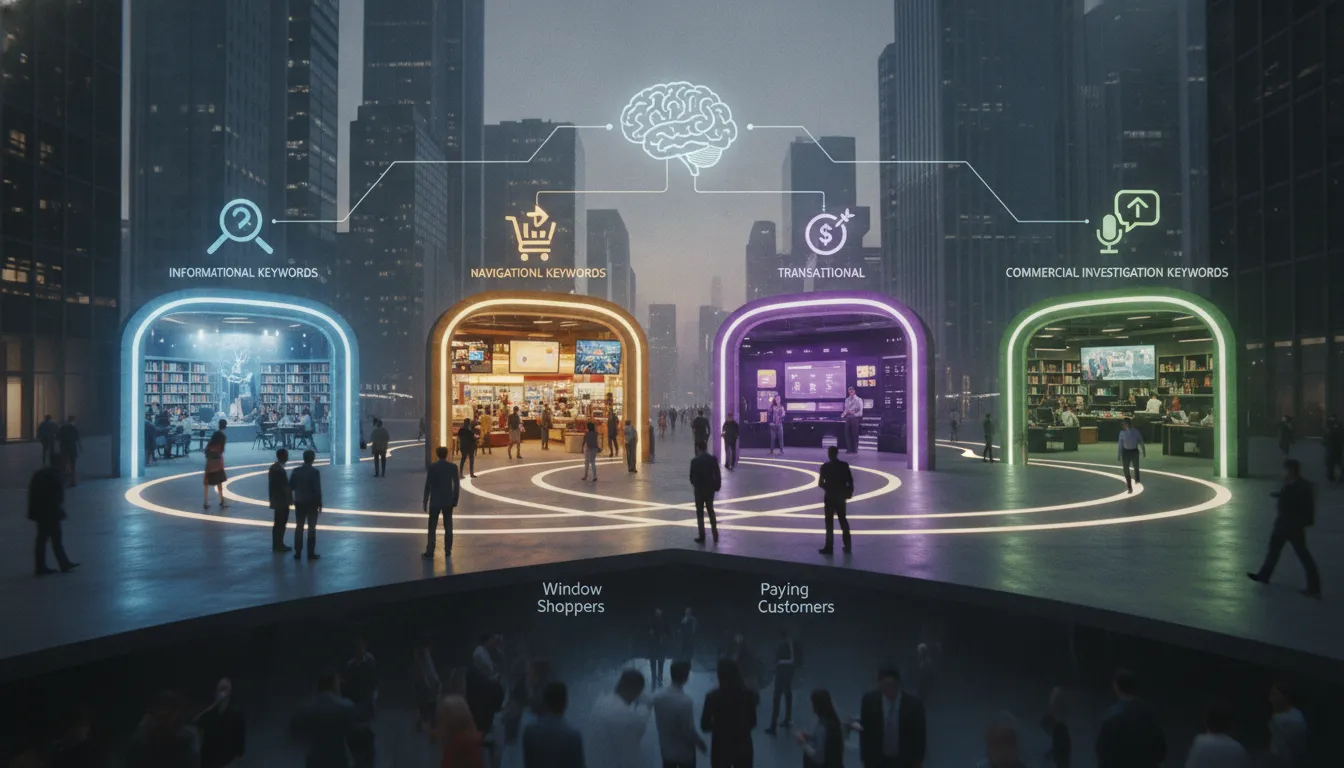
Imagine walking into a massive library looking for the perfect business consultant. In the past, the librarian handed you a catalog containing ten book titles and pointed you toward the shelves. You had to walk down the aisles, flip through the indexes, read several introductions, and figure out for yourself who was trustworthy.
Today, you are no longer handed a catalog. Instead, an experienced personal assistant steps forward, listens carefully to your exact business challenge, instantly reads every single book on the shelves, and says: “Based on your unique situation, here are the two exact experts you should hire, and here is why.”
That personal assistant is modern Artificial Intelligence.
Whether your prospective clients use ChatGPT, Google Gemini, Perplexity, or Microsoft Copilot, search behavior has undergone a profound transformation. People are no longer typing fragmented phrases like “best corporate accountant” into a search bar. They are having deep, nuanced conversations with AI engines, asking questions like: “I run a growing architecture firm with fifteen employees and want to transition to a subscription model. Which financial advisory firm specializes in this transition and has proven client results?”
If your business is not the one recommended by that AI assistant, you are invisible to some of the highest-paying, most qualified clients in your industry. To thrive in this new landscape, you must rethink your modern Digital Strategy from the ground up.
1. The New Landscape: Traditional Search vs. AI Search Engines

To win in this new era, it helps to understand how we got here. For nearly three decades, search engines operated like index registers. They scanned websites for specific keywords, calculated how many other websites linked to those pages, and presented a list of blue hyperlinks.
AI search engines work in a completely different way:
- Traditional Search Engines (The Matchmakers): They match the words you typed with the words on a web page and send you off to visit that site.
- AI Search Engines (The Synthesizers): They read, comprehend, summarize, and cross-reference thousands of sources in seconds. Rather than merely handing the user a link, they generate a direct, synthesized answer and cite the sources that contributed the most valuable information.
High-value customers love AI search engines because busy professionals do not want to click on ten different tabs and skim through sales pitches. They want synthesized, impartial, high-clarity recommendations. If you want to understand how broader content workflows are adjusting to this shift, take a look at How AI Is Transforming Content Creation Across Industries.
When an AI engine synthesizes an answer for a potential buyer, it acts as an executive researcher. It looks for content that displays genuine subject-matter authority, crystal-clear answers, transparent facts, and unambiguous solutions to real-world problems.
Your entire Digital Strategy must shift from simply “ranking for keywords” to “becoming the primary source cited by AI engines.”
2. The Core Pillars of an AI-Ready Digital Strategy

Transitioning your business presence so that artificial intelligence naturally discovers, reads, and recommends your website does not require an engineering degree. It requires clarity, structure, and helpfulness.
A modern, high-performing Digital Strategy designed for the AI era rests upon four fundamental pillars:
Pillar 1: Direct, Answer-First Content (The Inverted Pyramid)
Traditional web pages often bury the answer at the bottom of the page to keep visitors scrolling. AI search engines do the exact opposite: they scan for immediate, unambiguous value.
When creating articles, service pages, or case studies:
- State the core answer or solution directly in the first two sentences beneath any heading.
- Follow up that direct answer with concrete explanations, background details, and real-world examples.
- Summarize key findings in easy-to-read bullet points or clean comparison formats.
When an AI model scans a page that begins with a direct, comprehensive explanation, it recognizes that passage as a high-confidence quote it can present straight to the user.
Pillar 2: Demonstrating Real-World Experience (E-E-A-T)
Search algorithms and AI systems look closely at what Google calls E-E-A-T: Experience, Expertise, Authoritativeness, and Trustworthiness.
Anyone can use an AI tool to write generic filler text. Because the web is flooded with generic content, AI search engines favor websites that share authentic, firsthand human experience:
- Case Studies: Share the exact obstacles a real client faced, how your team solved them, and the tangible metrics achieved.
- Author Biographies: Ensure every educational article features an author box highlighting the author’s background, credentials, and industry experience.
- Firsthand Language: Use natural phrasing such as “In our twelve years working with logistics clients, we observed that…” Rather than detached, generic statements.
To learn how to modernize your keywords and content topics to meet these exact expectations, explore AI-Powered SEO: Automating Keyword Optimization for Maximum Visibility.
Pillar 3: Semantic Completeness (Covering the Topic from A to Z)
AI engines do not read your pages word-by-word in isolation; they analyze concepts. They look for context, related themes, and completeness.
If you write an article about commercial office leases, an AI engine expects to see related concepts discussed naturally on the page: security deposits, maintenance clauses, zoning regulations, square footage calculations, and exit terms. When you cover a subject holistically, the AI model views your website as a definitive topical authority. You can refine your existing pages by reading Revolutionize Your Website with AI-Powered Content Optimization Techniques.
Pillar 4: Structural Simplicity
AI search models use automated web crawlers to read the text of your site. If your content is hidden behind complex scripts, clunky layouts, or unorganized walls of text, the AI crawler simply moves on to your competitor. Clean organization is the key to being understood.
3. How to Format Content So AI Models Cite Your Brand
When an executive asks an AI engine for a vendor recommendation, the AI model does not invent its answers out of thin air. It extracts facts, statistics, and logical steps from established websites, synthesizing those pieces into a single response while hyperlinking the source.
Here is how you can structure your website pages so AI models love to cite your content:
Master the “Question and Answer” Layout
High-intent buyers ask specific questions. You should structure your main service pages and blog posts around these exact questions.
- Use questions as your section subheadings (H2s and H3s): Instead of using a vague header like “Our Pricing Approach,” use “How Much Does a Custom Web Application Cost in 2025?”
- Provide the straight answer immediately: Under that header, write a 2 to 3 sentence paragraph that directly answers the question before diving into deeper variables.
- Use descriptive lists: Break down multi-step processes or feature comparisons into concise bullet points. AI scrapers excel at extracting bulleted lists and presenting them as step-by-step guides in response to user queries.
To discover how compelling headlines capture both reader attention and algorithmic interest, read AI-Created Headlines: Boost Your Clicks with Automated News Titles.
Craft Unbeatable Summaries and Meta Information
Meta descriptions and introductory paragraphs serve as quick roadmaps for both humans and search robots. When an AI crawler evaluates your page, it uses your introductory summaries to determine whether your page answers the user’s intent.
If your introductory text is poetic or vague, the AI engine will struggle to categorize your page. If it is direct and informative, the AI can immediately identify your business as a solution provider. You can master this skill by reading AI-Crafted Meta Descriptions: The Secret Sauce for Instant Visibility.
Include Original Data, Research, and Frameworks
Why should an AI engine cite your website instead of Wikipedia or an industry news giant? Because you own original data.
You do not need an enterprise research budget to publish unique data:
- Survey your existing customers or email subscribers about an industry challenge and publish the percentages.
- Share internal benchmarks (e.g., “Across 50 client campaigns, we found that video testimonials increased conversion rates by 28%”).
- Name your unique business framework. Instead of calling your service “consulting,” give your 4-step framework a proprietary name. AI search engines love quoting named systems because they represent distinct, sourceable entities.
To see how high-performing teams combine automated writing tools with authentic thought leadership, review AI-Powered Content Magic: Instantly Boost Your Website’s Visibility and explore AI-Crafted Content: The Future of SEO and Web Design Mastery.
4. Web Design and User Experience: Designing for Both Humans and Robots
It is easy to get caught up in the written word, but how your website is built and designed plays an equally critical role in your Digital Strategy.
Consider this simple truth: What is easy for a human customer to navigate is almost always easy for an AI crawler to understand.
Fast, Clutter-Free Layouts Win
High-value clients have zero patience for slow, confusing websites. If a page takes seven seconds to load, has five different pop-up banners blocking the screen, and shifts around while reading, visitors leave immediately.
AI search engines take note of this behavior. If people who click through to your website from an AI summary immediately hit the “back” button because of a frustrating user experience, the AI algorithm learns that your website is not satisfying real users. Over time, the AI stops recommending your business.
To build clean, visually persuasive pages that keep visitors engaged and convert them into paying clients, study AI-Powered Web Design: Layouts That Convert Visits into Sales.
Maintain Your Site Easily Without Technical Headaches
Many entrepreneurs feel overwhelmed by website upkeep. They worry that keeping their website fresh, secure, and modern requires hiring an expensive development agency for every small change.
Fortunately, modern tools make maintaining your website straightforward. You can easily update your pages, fix broken links, and keep your core platform updated by using conversational AI assistants. If you want to streamline this process, check out our guide on How to Manage Your WordPress Website with ChatGPT or Claude.
5. Local Optimization: How AI Engines Find Nearby Service Providers
Many high-value clients look for services within their immediate geographical region. A private equity fund looks for an accounting firm in Chicago; an upscale homeowner searches for an interior architect in London; a medical clinic seeks an IT security provider in Austin.
When users ask an AI assistant for a local recommendation, the AI does not just scan your website text; it synthesizes multiple external trust signals:
- Consistent Business Information (NAP): Your Name, Address, and Phone Number must be 100% identical across your website, Google Business Profile, Apple Maps, and local directories. AI engines get confused when they find conflicting addresses or phone numbers.
- Detailed Service Areas: Do not simply say, “We serve the greater tri-state area.” Create dedicated, helpful pages for each major city or district you operate in, mentioning distinct landmarks, local regulations, and client stories specific to that area.
- Unsolicited Customer Reviews: AI search engines read customer reviews across multiple platforms. They analyze sentiment, looking for recurring words like “punctual,” “responsive,” “professional,” and “worth the investment.”
If you run a service business or brick-and-mortar company, you can master these local tactics with our step-by-step tutorial: The Non-Technical Guide to Dominating Local Search and Winning Nearby Customers.
6. The 5-Step Action Plan to Make Your Website AI-Ready
Now that you understand the theory and mechanics behind AI search optimization, let us turn these concepts into a concrete action plan you can implement starting this week.
Step 1: Audit Your Top 5 Revenue-Generating Pages
Identify the five pages on your website that bring in your highest-value clients (usually your primary service or product pages). Read each page through the eyes of an AI assistant:
- Does the page state clearly what you do, who you do it for, and what specific problem you solve within the first 100 words?
- Are there clear subheadings answering the biggest questions a prospective client might have?
- Is pricing, process, or engagement scope explained transparently?
If an answer is missing or buried under vague marketing buzzwords, rewrite that section with crystal-clear facts.
Step 2: Build a Dedicated “Frequently Asked Questions” (FAQ) Hub
Every entrepreneur knows the twenty questions prospects ask during sales calls. Instead of keeping those answers inside your sales deck or email inbox, publish them on your website.
Create a comprehensive FAQ section for your core services:
- State the question clearly as an H3 heading.
- Provide a crisp, authoritative 2- to 4-sentence answer directly underneath.
- Link to a longer, detailed case study or guide for readers who want to explore deeper.
When AI engines look for authoritative snippets to answer complex customer queries, these FAQ formats provide the ideal structure for quotation.
Step 3: Publish Detailed Case Studies with Verifiable Results
Vague testimonials like “Working with this team was great!” carry very little weight with AI engines or savvy human buyers.
Upgrade your client success stories into structured case studies following this simple format:
- The Client Profile: Who they are, their industry, and their initial state.
- The Challenge: The specific operational or strategic hurdles they encountered.
- The Solution: The exact process, strategy, and services your company deployed.
- The Measurable Outcome: The concrete results achieved (e.g., “Reduced customer onboarding time by 42% over six months”).
This concrete cause-and-effect narrative gives AI models the factual evidence they need to confidently recommend your firm as a verified problem-solver.
Step 4: Establish Personal and Brand Authority Across the Web
AI engines cross-reference your website with the rest of the internet to verify your credibility. They check whether other reputable publications, podcast interviews, industry associations, and news outlets mention your brand.
- Write guest thought-leadership articles for respected industry publications.
- Appear as a guest on relevant business podcasts and request that the host link back to your company’s resource page in the episode show notes.
- Keep your LinkedIn company page and founder profiles updated with consistent company descriptions and credentials.
The more consistently your brand is mentioned across credible third-party platforms, the higher the confidence score an AI model assigns to your website.
Step 5: Speak Naturally (Ditch Corporate Jargon)
For years, websites were stuffed with awkward corporate jargon: “We leverage synergistic paradigms to deliver holistic enterprise solutions.”
Nobody speaks that way in real life, and AI models—trained on natural human dialogue—prioritize straightforward language. Write your website copy the same way you would explain your business to an intelligent peer over coffee:
- Use active voice (“We help medical practices streamline appointments” instead of “Appointments are streamlined by our system”).
- Define industry terms immediately if you must use them.
- Focus on tangible outcomes rather than abstract concepts.
7. The Future of Search: Turning AI Recommendations into Lifelong Clients
The evolution from traditional keyword search to generative AI search is not a passing trend; it is the natural evolution of how humans seek information. People have always preferred speaking with a knowledgeable advisor over sifting through an endless catalog of brochures.
When you optimize your website for AI search engines, you are not chasing a fleeting algorithm trick. You are making your website:
- Clearer in its value proposition.
- Easier to navigate for real human prospects.
- Richer in verified evidence and expertise.
- Direct and authoritative in its answers.
By integrating these fundamentals into your comprehensive Digital Strategy, your business will do more than survive the AI transition—it will stand out as the premier, trusted authority that intelligent search assistants recommend to high-value clients every single day. Start with small, consistent structural improvements today, and watch your business become the definitive choice in your market.
Ready to Scale Your Digital Infrastructure?
Discuss your project around How to Optimize Your Website for AI Search Engines and Win High-Value Customers directly with our senior experts.